

Wi‑Fi has quietly become one of the most important smartphone specifications. Cameras and processors get the headlines, but a modern phone can spend most of its day moving data over a wireless network. That is why Wi‑Fi 7 (802.11be) matters: it is designed not only for higher peak throughput, but also for better use of available spectrum, lower latency and more resilient connections in busy environments.
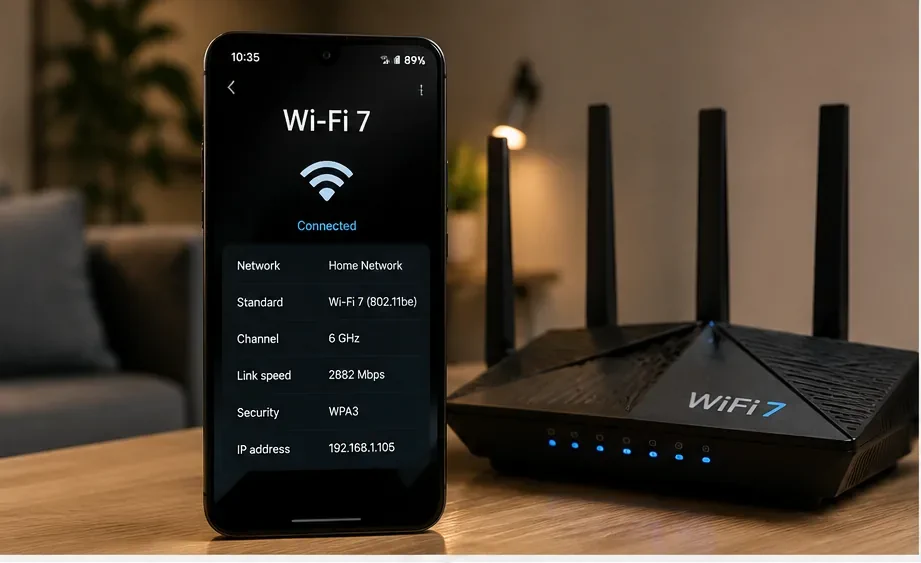
Wi‑Fi 7 is already moving into mainstream flagship phones
Apple officially lists Wi‑Fi 7 support on the iPhone 16 family and on the newer iPhone 17 generation. The iPhone 17 specifications list 802.11be with 2x2 MIMO, while Apple’s deployment documentation also confirms support across the 2.4 GHz, 5 GHz and 6 GHz bands and Multi‑Link Operation on compatible models. Android flagships have been moving in the same direction, making Wi‑Fi 7 an increasingly common feature rather than an exotic specification.
The important detail is that “supports Wi‑Fi 7” does not mean every smartphone implements every theoretical capability of the standard. Antenna configuration, channel width, regional 6 GHz rules, router capability, firmware and the internet connection itself can all limit real-world performance.
Key takeaway
Wi‑Fi 7 is becoming standard on premium smartphones, but the badge alone does not guarantee dramatically faster everyday browsing. Here is what 802.11be, Multi‑Link Operation, wider channels and modern phone hardware actually change for Android and iPhone users.
Wi‑Fi 6 vs Wi‑Fi 6E vs Wi‑Fi 7
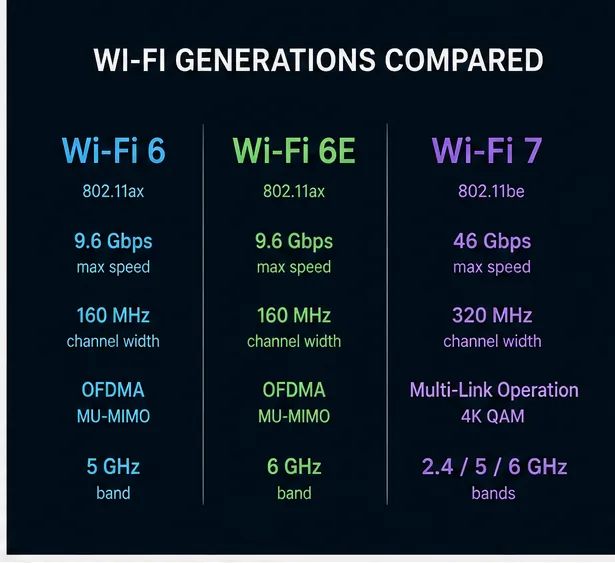
Wi‑Fi 6 and Wi‑Fi 6E remain very capable. Wi‑Fi 6E extended Wi‑Fi 6 technology into the cleaner 6 GHz band, while Wi‑Fi 7 builds on that foundation with new tools intended to increase capacity and reduce congestion. The full 802.11be specification can support extremely wide 320 MHz channels, higher-order 4K QAM modulation and Multi‑Link Operation (MLO).
MLO is particularly interesting for phones because a compatible device and router can coordinate links across different bands instead of treating each band as a completely isolated connection. Depending on implementation, this can improve throughput, responsiveness or reliability. It is the type of improvement that may be more noticeable during a large local file transfer, cloud backup, high-bitrate streaming or latency-sensitive gaming than during ordinary web browsing.
5 min read
iPhone coverage from PhonesGATE. Published Aug 16, 2026.
Why 320 MHz and 4K QAM do not automatically mean huge phone speeds
Theoretical Wi‑Fi 7 numbers can be spectacular, but smartphone hardware is deliberately compact and power constrained. A phone does not have the antenna array, thermal budget or radio configuration of a high-end desktop adapter. Apple, for example, documents a maximum 160 MHz channel width and 2x2 MIMO for current Wi‑Fi 7 iPhones. That is an important reminder that the Wi‑Fi generation and the exact radio implementation are two different specifications.
4K QAM can carry more information per transmission than the modulation used by earlier generations, but it works best when signal quality is excellent. Move farther from the access point, add walls or interference, and the connection may automatically fall back to a more robust modulation mode. In other words, Wi‑Fi 7 is engineered to adapt; it is not a permanent “maximum speed” switch.
Where a Wi‑Fi 7 phone can feel better
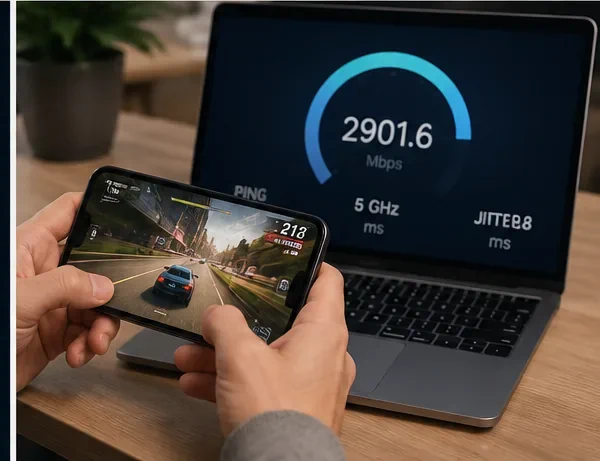
Local transfers are one of the clearest use cases. Moving large video files to a NAS, syncing a photo library or downloading assets from a local server can expose the difference between generations far more clearly than loading a normal website. Gaming and video calls can also benefit when a network is congested, because consistency and latency matter as much as raw throughput.
Wi‑Fi 7 also makes more sense in homes with multi-gigabit fiber and many active devices. If your internet connection is 300 or 500 Mbps and your existing Wi‑Fi 6 network already reaches that speed reliably, changing phones solely for Wi‑Fi 7 is unlikely to transform everyday use. The router and backhaul must be capable enough to expose the phone’s additional wireless headroom.
Android vs iPhone: the logo does not tell the whole story
For buyers comparing Android and iPhone models, the correct question is not simply “Does it have Wi‑Fi 7?” Check the implementation. Look for supported bands, whether 6 GHz is available in your market, MLO support, MIMO configuration and maximum channel width. Two phones can both advertise 802.11be while delivering different peak rates or behaving differently with the same router.
Apple’s current documentation is unusually useful here because it specifies radio details rather than stopping at the Wi‑Fi 7 label. Android manufacturers vary in how much information they publish, so buyers should treat unsupported assumptions cautiously and verify the exact regional model.
Do you need Wi‑Fi 7 in your next smartphone?
If you keep a flagship phone for three to five years, Wi‑Fi 7 is a worthwhile future-proofing feature. Routers, fiber connections, local storage and streaming workloads will continue to become faster, and a phone bought today may spend most of its life in a more demanding wireless environment than the one you have now.
But Wi‑Fi 7 should not outrank display quality, battery life, cameras, software support or cellular performance when choosing between otherwise different phones. For many users, a well-implemented Wi‑Fi 6E connection is already fast enough. Wi‑Fi 7 becomes compelling when the rest of the network is ready to take advantage of it.
PhonesGate verdict
Wi‑Fi 7 is a meaningful smartphone upgrade, but its biggest advantage is efficiency and headroom rather than a magical speed boost. MLO, modern spectrum use and higher-capacity links give new devices a stronger foundation for multi-gigabit networks and increasingly demanding wireless workloads. Buy it as part of a strong overall phone—not because of one enormous theoretical speed number on a specification sheet.