

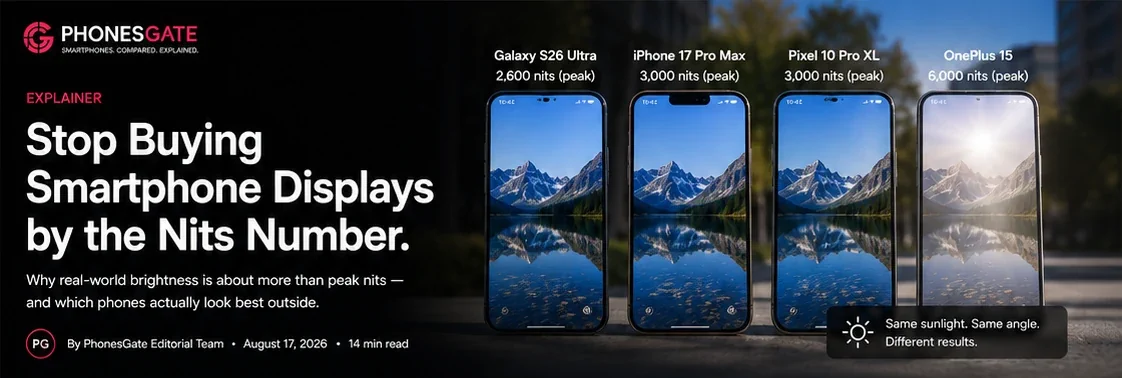
Peak brightness has become one of the most abused numbers in smartphone marketing. A spec sheet might advertise 2,500, 3,000, 4,500 or even 6,000 nits, but that does not automatically tell you which display will be easiest to read outdoors or which phone will look best in real-world use.
The reason is simple: peak nits are only one piece of the display equation. Sustained full-screen brightness, reflectivity, anti-reflective coatings, contrast, viewing angles, automatic brightness behavior and Average Picture Level (APL) all influence what your eyes actually see.
Peak brightness is not the same as sustained brightness
Peak brightness usually refers to the highest luminance a display can reach under specific conditions, often over a relatively small portion of the screen and for a limited period of time. That is useful for HDR highlights, but it is very different from maintaining high brightness across a large white webpage, map or document in direct sunlight.
Key takeaway
PhonesGate explains why peak nits are a poor way to judge smartphone displays and why sustained brightness, reflectivity, APL and outdoor readability matter more.
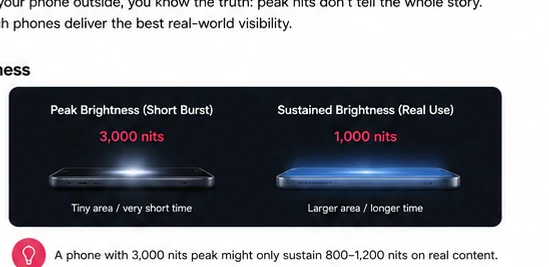
This is why a phone with an enormous advertised peak value can still look ordinary outside. If the panel cannot hold enough brightness across a meaningful portion of the display, that record-setting number may have little impact on readability.
Reflection is often the real outdoor enemy
Outdoor visibility is not just about how much light the display emits. It is also about how much ambient light bounces back into your eyes. A panel with lower reflectivity can look clearer and more contrasty even when another phone produces a higher measured brightness.
5 min read
PhonesGate coverage from PhonesGate. Published Aug 22, 2026.
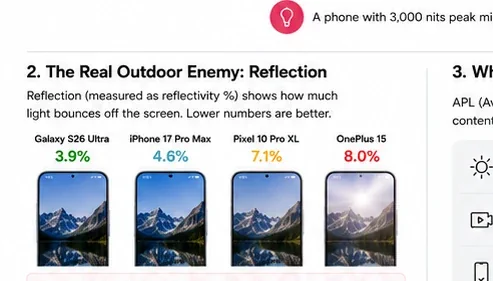
This is where anti-reflective glass and coatings matter. Samsung has pushed hard in this area on its Ultra models, and independent testing has shown that lower reflection can materially improve outdoor readability. A phone does not need the highest nits figure to look better in harsh light if it is losing less contrast to reflections.
What is APL and why does it matter?
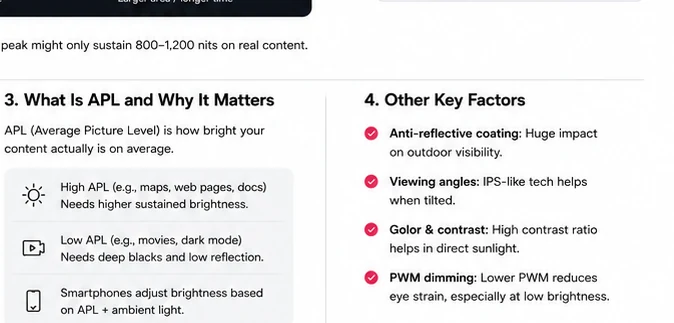
Average Picture Level describes how much of the screen is bright at a given moment. A small HDR highlight is a low-APL scenario. A mostly white browser page, spreadsheet or map is a much higher-APL workload.
OLED displays can behave very differently depending on APL because power and thermal limits influence how much brightness the panel can sustain. That is why lab measurements taken at multiple APL levels are far more informative than one isolated peak value.
Why the same sunlight produces different results
Two phones can sit side by side under the same sun and still look very different. One may technically output more light, but the other may preserve black levels and contrast better because of superior anti-reflective treatment. Viewing angle also matters: a display that looks excellent head-on can lose contrast or color accuracy when tilted.
Automatic brightness algorithms are another hidden variable. Some phones enter a high-brightness mode aggressively when the ambient sensor detects sunlight, while others are more conservative to control heat or battery drain. That behavior can matter more in daily use than the maximum number printed on the product page.
Real-world display showdown: what to compare instead
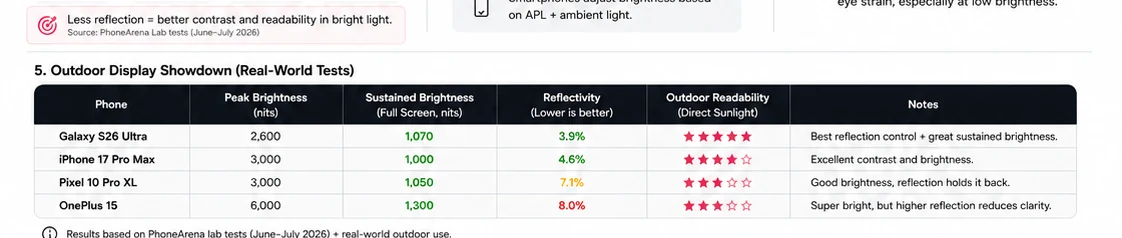
When PhonesGate compares smartphone displays, we recommend looking at several metrics together rather than ranking phones by one peak-nits number:
- Sustained brightness: how bright the display can remain during normal full-screen use.
- Reflectivity: how much ambient light the glass sends back to your eyes.
- High-brightness mode behavior: how quickly and how long the phone boosts brightness outdoors.
- Viewing angles: whether contrast and colors remain stable when the screen is tilted.
- Color and contrast: a bright image is not automatically a good image.
- PWM and dimming behavior: especially relevant for users sensitive to display flicker.
Why 6,000 nits can be less useful than it sounds
Huge marketing numbers often describe the best-case output of a tiny screen region. They can still be legitimate measurements, especially for HDR highlights, but they should not be interpreted as “this entire display runs at 6,000 nits outdoors.” That is not how modern OLED power management works.
The number also says nothing about reflection. A highly reflective panel can wash out more severely under the sun even when it has a higher luminance ceiling. This is why direct outdoor tests remain one of the most useful ways to evaluate flagship displays.
What should you actually look for when buying a phone?
If outdoor readability matters to you, prioritize a combination of strong sustained brightness and low reflectivity. If you watch a lot of HDR video, peak brightness becomes more relevant because bright highlights can improve perceived dynamic range.
For everyday use, also pay attention to whether the display remains comfortable at low brightness, how well it handles automatic brightness transitions, and whether color accuracy changes noticeably off-axis.
PhonesGate take
Stop treating nits like horsepower. A bigger number is not automatically a better display. Peak brightness is useful, but it is one metric inside a much larger system.
The best smartphone display is the one that remains readable, accurate and comfortable across the situations you actually use it in. That means balancing sustained brightness, reflection control, contrast, viewing angles and software behavior.
Next time a phone advertises an enormous peak-nits figure, read the number — then keep reading. Your eyes care about the whole display, not the headline specification.