

For years, Samsung's Galaxy Z Fold lineup has had to answer the same question: how durable can a folding phone really be? The Galaxy Z Fold8 arrives with a more mature design, a redesigned hinge and stronger materials, but specifications alone cannot answer that question.
That is why the latest durability test is so interesting. The Galaxy Z Fold8 is pushed through deliberate scratching, heat, debris and extreme bending. The results show where Samsung's latest foldable has become significantly tougher — and where owners still need to be careful.
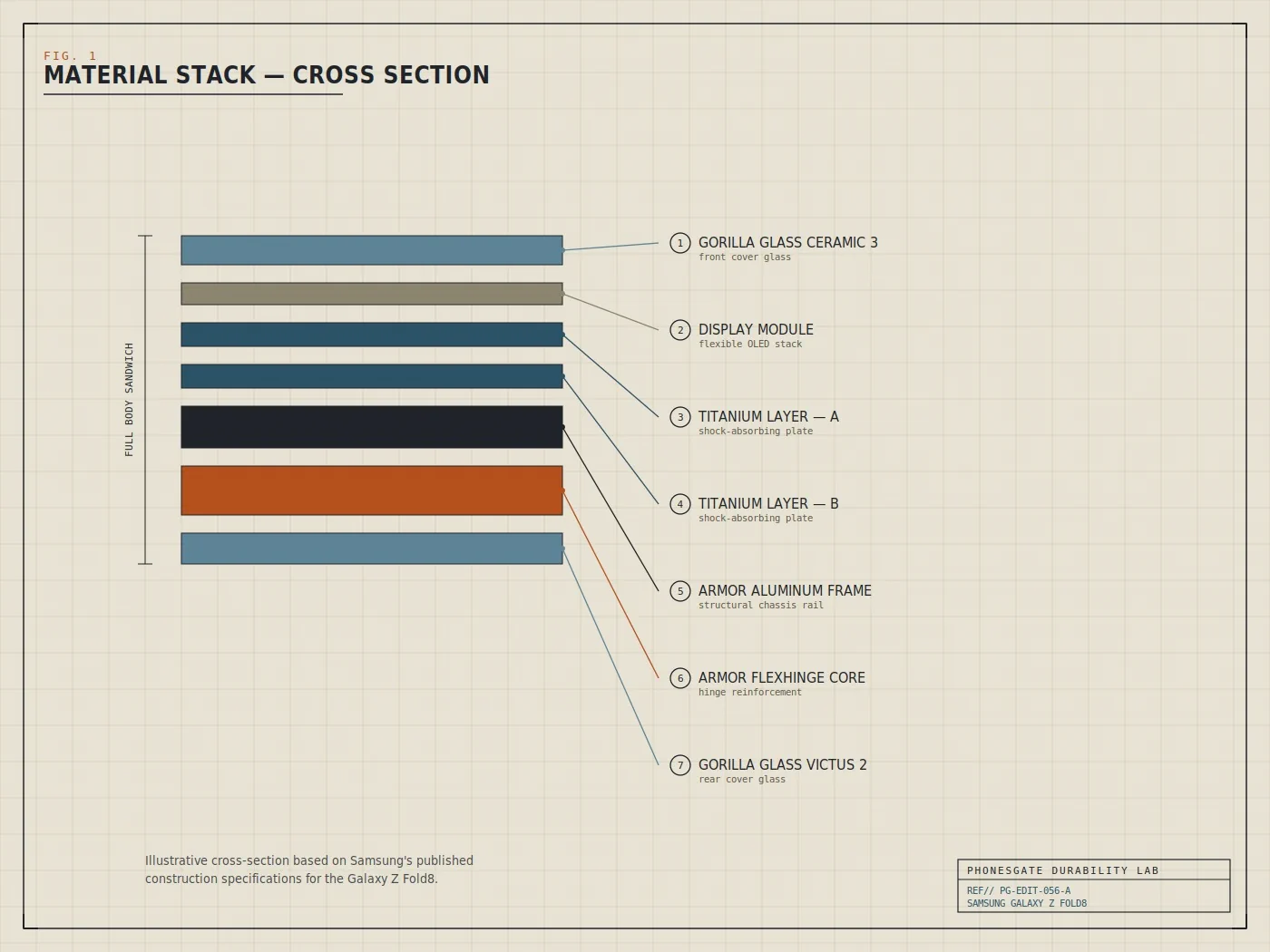
Samsung says the Fold 8 was built for durability
Samsung uses an Armor Aluminum frame, Corning Gorilla Glass Ceramic 3 on the front and Gorilla Glass Victus 2 on the rear. The internal structure also includes two titanium layers underneath the display, while the redesigned Armor FlexHinge is designed to be thinner without sacrificing rigidity.
Key takeaway
The Samsung Galaxy Z Fold8 faces an extreme durability test. Here is what the hinge, frame, titanium reinforcement and inner display reveal about the new foldable's toughness.
The Fold8 also carries an IP48 rating. That is meaningful protection, but it should not be interpreted as complete dustproofing or as protection from fine sand.
The durability test is where things get interesting
The test is deliberately much harsher than normal use. Its purpose is to expose structural weaknesses rather than reproduce an ordinary drop or pocket accident.
5 min read
Samsung coverage from PhonesGate. Published Aug 11, 2026.
The Fold8's most interesting result comes when significant mechanical force is applied to the phone. Instead of immediately suffering catastrophic structural failure, the device remains functional through the extreme portion of the test.
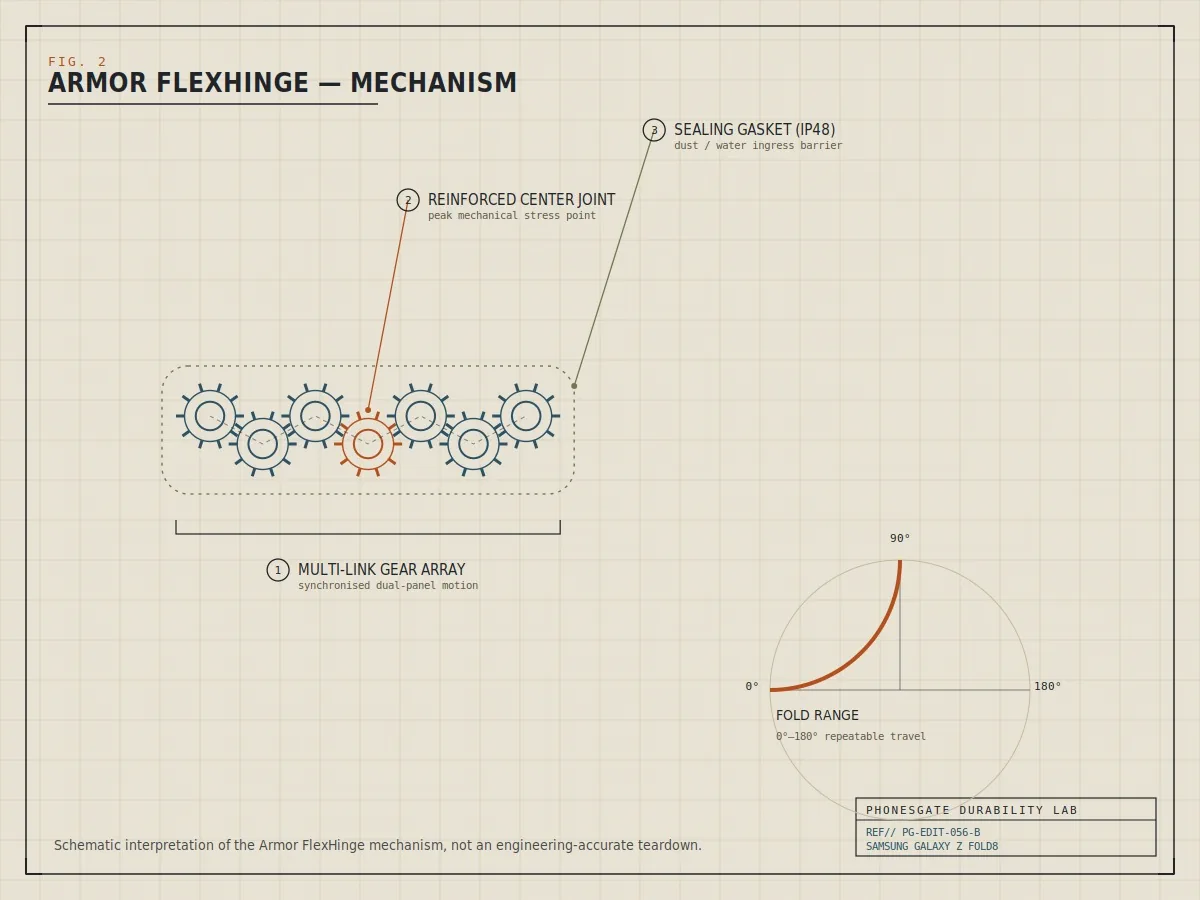
The hinge is no longer the obvious weak point
The hinge is one of the most important components of any foldable because it moves every time the phone opens and closes while protecting the flexible display and internal components.
Samsung's Armor FlexHinge appears to handle substantial mechanical stress without immediately failing. That is important because early generations of foldables were often judged primarily by concerns about their hinge mechanism.
The inner display is still the weak point
A foldable is still a foldable. The external glass is significantly more resistant to scratches than the flexible inner display, which remains the component requiring the most care.
That is not necessarily a design failure. A conventional smartphone can use rigid glass across the entire display; a foldable requires a display stack that can bend repeatedly. Flexibility inevitably creates a different durability trade-off.
What happens when dust gets involved?
The IP48 rating provides defined protection against water and larger particles, but fine dust and sand remain things owners should avoid. Taking a foldable to a beach and deliberately exposing its hinge and inner screen to fine sand is still a bad idea.
The bend test is the real headline
A foldable is designed to bend in one direction. Forcing it in the opposite direction places extreme stress on the hinge, display layers and internal frame.
The Fold8's ability to remain functional through severe backward bending is therefore more meaningful than a simple scratch test. It suggests Samsung has built substantially more structural tolerance into the device than its thin profile might suggest.
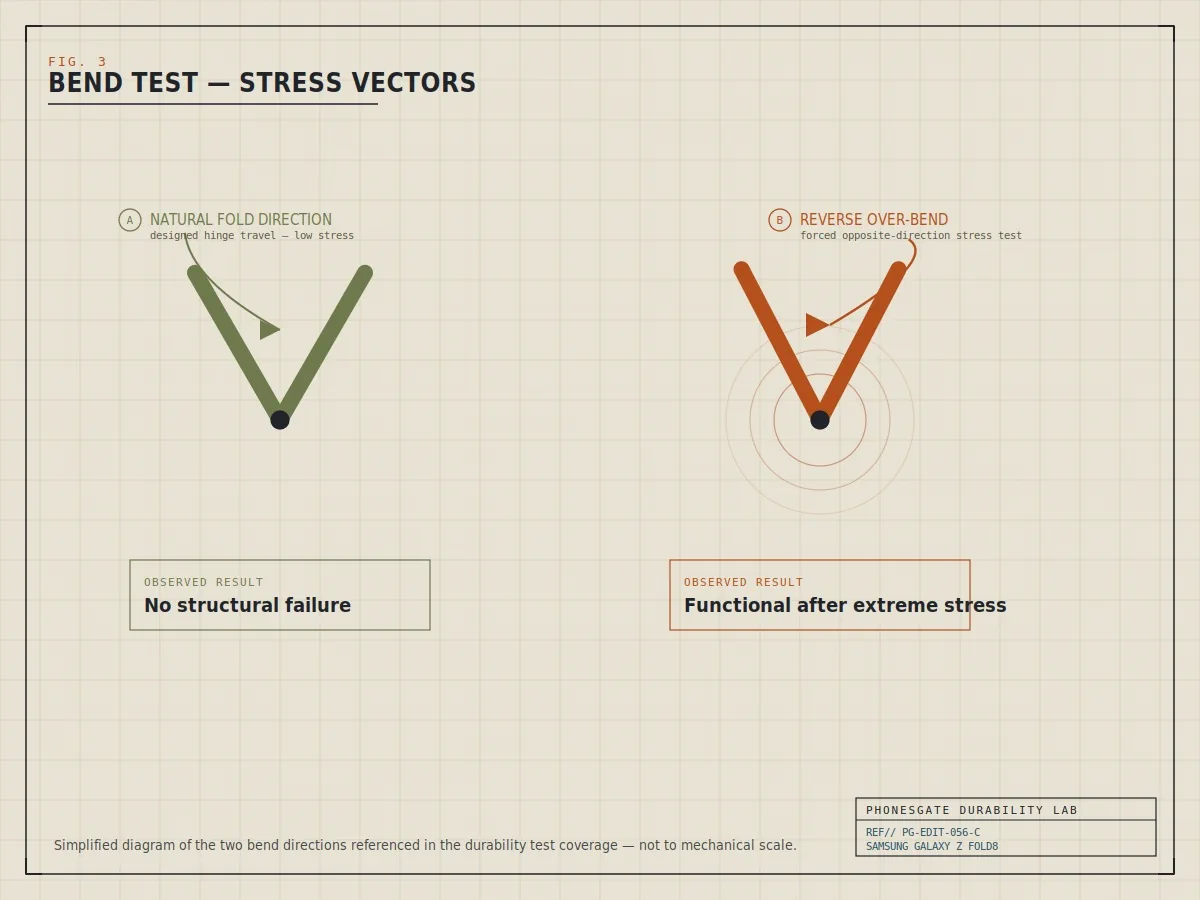
Does this make the Galaxy Z Fold8 more trustworthy?
Yes — with an important qualification. The test provides strong evidence of improved structural durability. Armor Aluminum, titanium reinforcement, the redesigned hinge and strengthened external glass all contribute to a more resilient package.
But the inner display still requires more care than a conventional smartphone screen. The Fold8 should be treated as a sophisticated mechanical device rather than a rugged phone.
What Samsung changed
- Armor Aluminum frame
- Two titanium layers beneath the inner display
- Armor FlexHinge
- Gorilla Glass Ceramic 3
- Gorilla Glass Victus 2
- IP48 protection
The real-world durability question
There is still one question that no single torture test can answer: how will the Galaxy Z Fold8 look after three years of everyday use?
Repeated opening and closing, pocket debris, accidental drops and long-term contact with the inner screen are very different from a controlled test. The early evidence is encouraging, but long-term reliability will ultimately be established by owners over time.
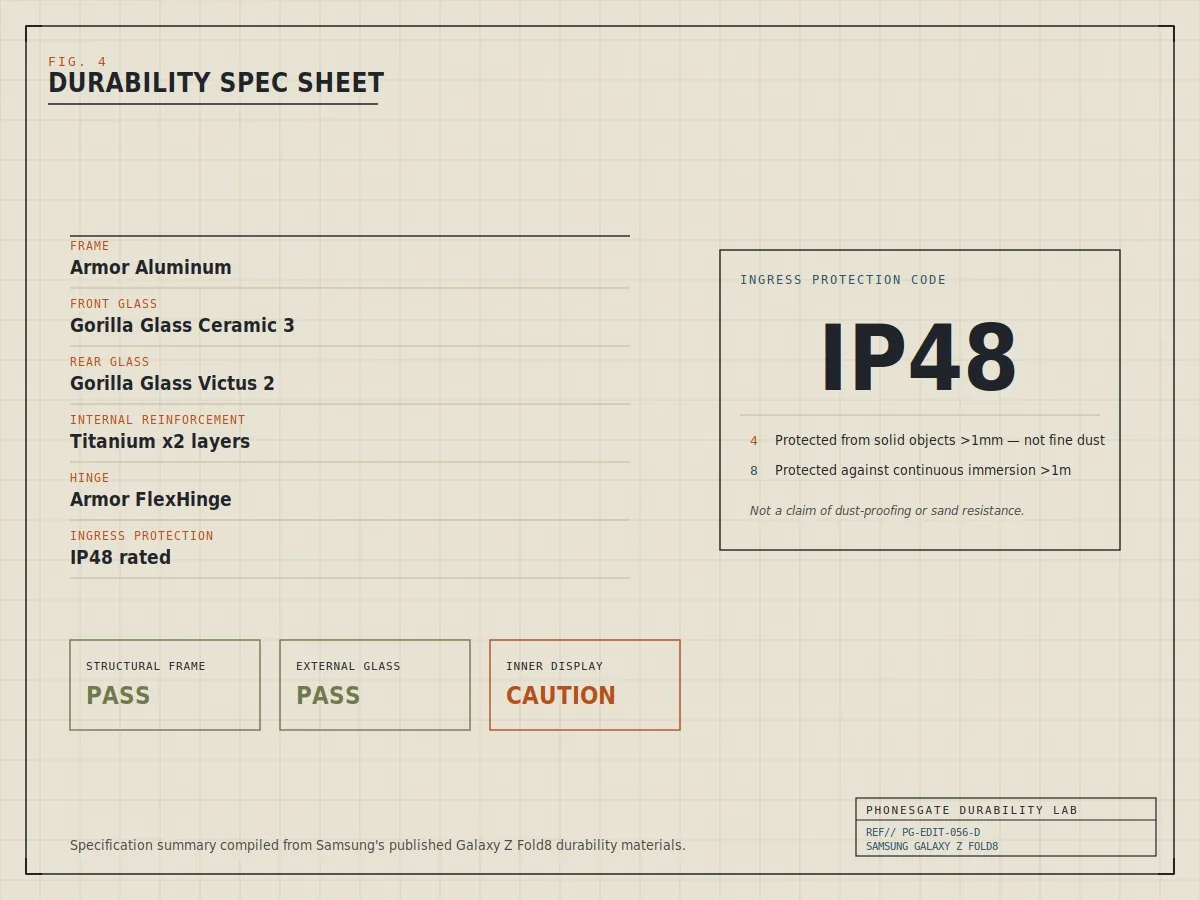
PhonesGate Take
The Galaxy Z Fold8's durability test changes the conversation around Samsung's foldables. For years, the biggest criticism was simple: they are too fragile.
The latest Fold8 makes that argument considerably harder to defend. Samsung has strengthened the structural architecture, and the extreme bend test suggests that a modern Galaxy Fold is considerably more resilient than its delicate appearance might imply.
Final Verdict
Did Samsung finally build a foldable you can trust? For structural durability, the answer looks like yes.
The Galaxy Z Fold8 appears surprisingly resilient under extreme abuse. The combination of titanium reinforcement, Armor Aluminum, stronger glass and the new FlexHinge is a convincing step forward.
But trust does not mean treating it like a rugged phone. Keep sand away from the hinge, avoid sharp objects against the inner display and do not intentionally reproduce an extreme durability test.
For normal everyday use, however, the Galaxy Z Fold8 looks much closer to the point where you can simply use it as a phone — rather than constantly worrying that you are carrying a fragile experiment.
Frequently Asked Questions
Is the Galaxy Z Fold8 durable?
Yes. Samsung uses Armor Aluminum, titanium reinforcement, strengthened Corning glass, the Armor FlexHinge and IP48 protection.
Can the Galaxy Z Fold8 survive bending?
The published extreme durability test shows the Fold8 surviving severe backward bending while remaining functional.
Is the inner Galaxy Z Fold8 screen scratch resistant?
The flexible inner display remains more vulnerable to scratching than the external glass. This is a known trade-off of flexible display technology.
Is the Galaxy Z Fold8 waterproof?
The phone has an IP48 rating. This provides defined water and particle protection but should not be interpreted as complete waterproofing or fine-dust protection.
Does the Galaxy Z Fold8 have titanium?
Yes. Samsung uses two titanium layers in the shock-absorbing structure underneath the inner display.