

For years, the foldable-phone market has lived in a strange space: technically impressive, increasingly refined, but still separate from the mainstream smartphone conversation. Samsung kept iterating. Huawei, Honor, Oppo and others pushed thinner bodies, bigger batteries and increasingly ambitious form factors. Apple watched from the sidelines.
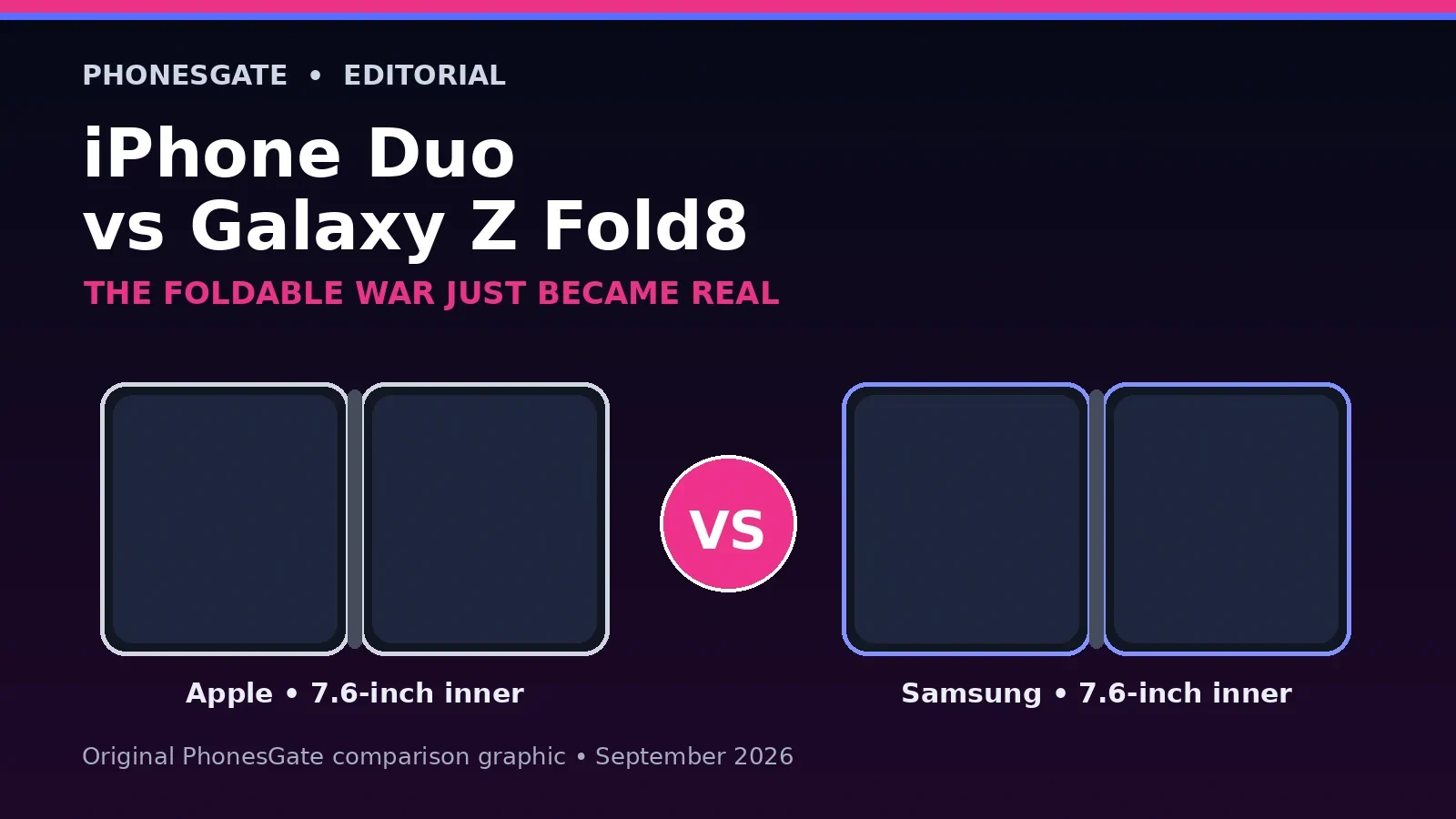
That changed on September 9, 2026. Apple officially unveiled the iPhone Duo, its first foldable iPhone, with a 7.6-inch inner display, a 5.4-inch outer display, the new A20 Pro chip and a starting price of $1,999. The device is scheduled to reach customers on October 23. Suddenly, the most important question around foldables is no longer whether Apple will enter the category. It is what happens now that it has.
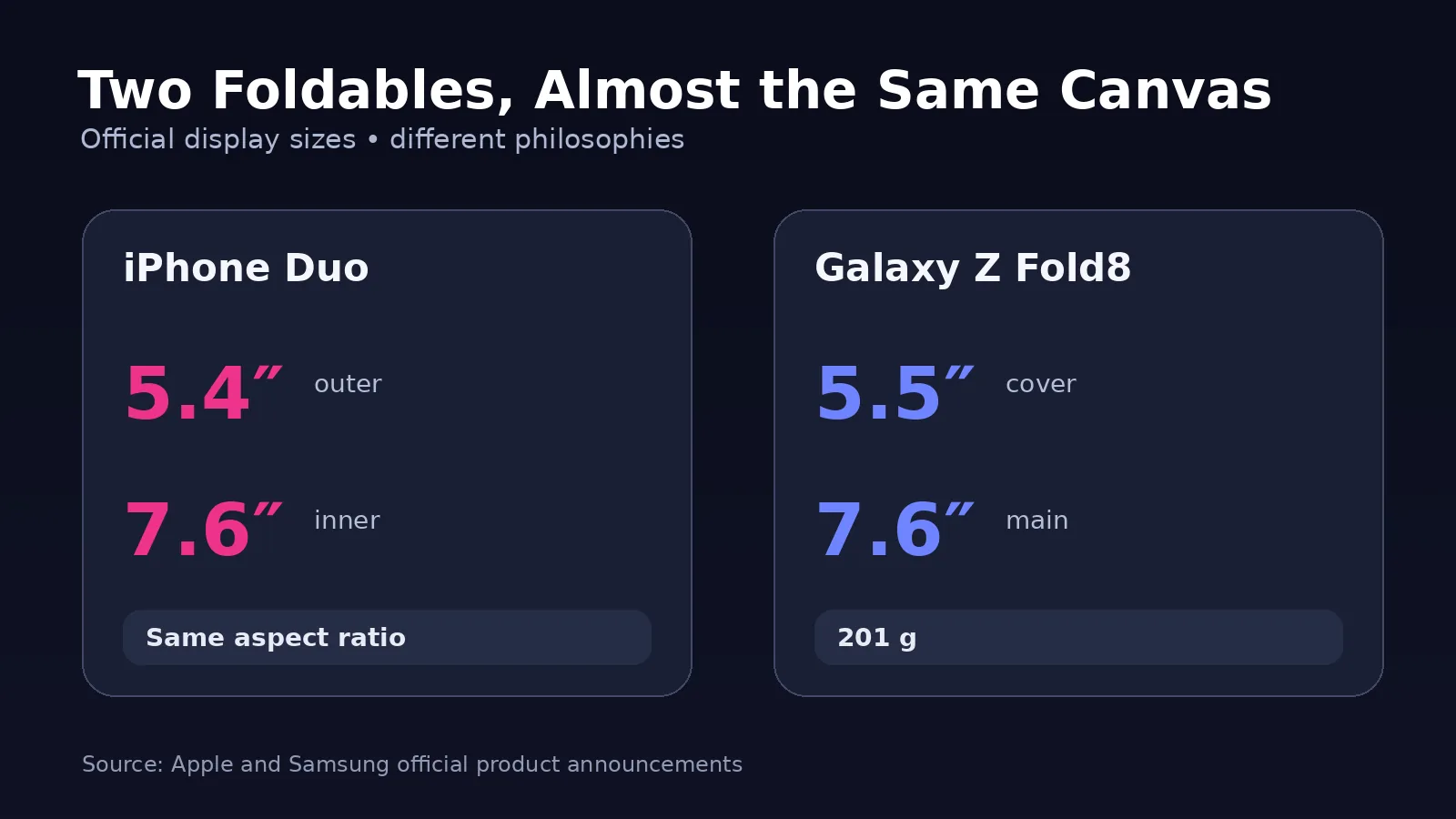
Across the aisle, Samsung's Galaxy Z Fold8 is already on the market after eight generations of foldable development. Its 7.6-inch main screen, 5.5-inch cover screen, 201-gram body and $1,899.99 U.S. starting price make it the most direct rival to Apple's new device. On paper, the two phones are separated by only about $100. In practice, they represent two very different kinds of advantage.
Key takeaway
Apple has finally entered the foldable-phone market with the $1,999 iPhone Duo. Samsung already has eight generations of experience behind the Galaxy Z Fold8. This is more than a specs fight — it could decide whether foldables finally become mainstream.
This is where the foldable market gets genuinely interesting.
Apple arrived late — and that may be the point
Apple did not invent the foldable phone, and it is not pretending that it did. Samsung has spent years absorbing the difficult lessons of flexible displays, hinge engineering, multitasking interfaces and durability. The original Galaxy Fold launched into a market that was not fully ready for it; the Fold8 arrives after multiple rounds of redesign and real-world feedback.
9 min read
Apple coverage from PhonesGate. Published Sep 12, 2026.
Apple's advantage is different. It can enter after the category has already solved many of its early hardware problems and focus on integrating the form factor into an ecosystem with enormous developer reach. The iPhone Duo's most important feature may therefore not be the hinge or even the display. It may be the fact that it forces the iOS ecosystem to treat foldables as a first-class device category.
Two 7.6-inch screens, two different approaches
Apple says the iPhone Duo uses a 5.4-inch outer Super Retina XDR display and a 7.6-inch inner Super Retina XDR display. Both panels share the same aspect ratio, which is designed to make content scale proportionally as the phone moves between closed and open states. The inner screen also uses a nano-textured finish intended to reduce glare and make the crease less visually distracting. Apple lists ProMotion, Always-On support and up to 3,000 nits of peak outdoor brightness for both displays.
Samsung took a slightly different route with the Galaxy Z Fold8. Its 5.5-inch cover display is paired with a 7.6-inch main display that opens into a 4:3 aspect ratio. Rotate the phone and Samsung says the layout becomes 3:4, while the cover screen uses a familiar 10:16 ratio. Samsung's goal is less about maintaining an identical visual relationship between the two screens and more about making each orientation useful for a particular kind of content.
The Fold8 also weighs just 201 grams, an important figure because weight has historically been one of the most obvious compromises of book-style foldables. Samsung lists a 4,800mAh battery and more than 26 hours of video playback. Apple, meanwhile, uses a battery on each side of the Duo and claims up to 31 hours of video playback on the inner display, up to 44 hours on the outer display and up to 24 hours of mixed usage. Those manufacturer figures are measured differently, so they should not be treated as a direct battery benchmark.
The real fight is software, not the hinge
This is the section that could decide whether the iPhone Duo matters beyond launch-week excitement.
iOS 27 introduces Split View on iPhone, allowing two apps to run side by side on the Duo's inner screen. Users can open two windows from the same app — Apple uses Safari as an example — swap apps quickly and save app pairs to return to later. Apple also says developers can adapt their apps using updated APIs, and it has already highlighted foldable-aware experiences from Netflix, Zoom and Slack.
That matters because the biggest weakness of the foldable category has never been simply that the screens crease. It is that a larger screen needs software that justifies carrying a more complicated device. If an unfolded phone merely stretches a normal phone interface, the form factor becomes an expensive novelty. If it consistently lets users research, message, edit, watch and work more effectively, the extra screen starts earning its place.
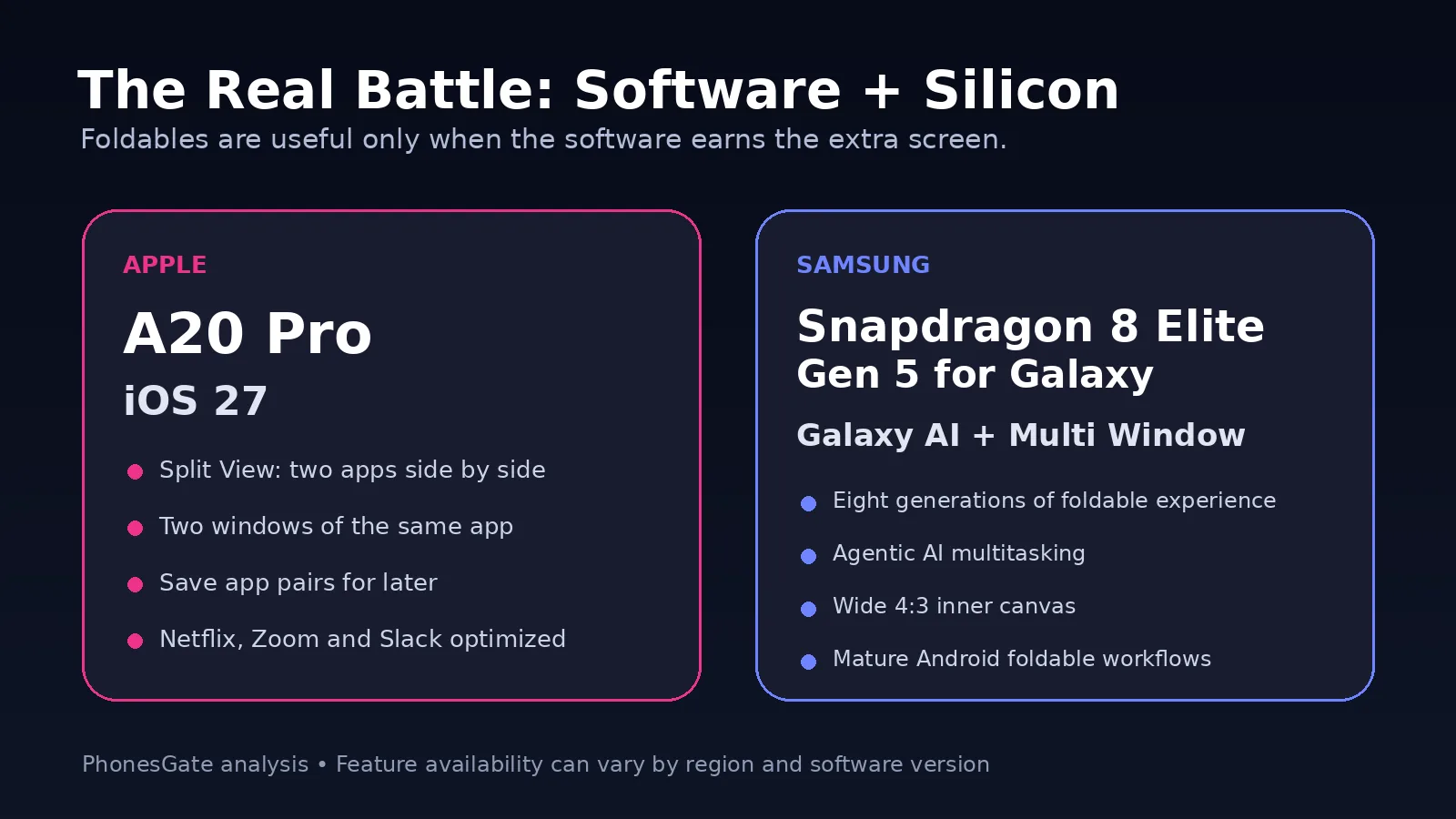
Samsung has a huge head start here. Multi Window, drag-and-drop workflows and large-screen Android behavior have been part of the Galaxy Fold story for years. The Fold8 also leans heavily into Galaxy AI and agentic multitasking. Samsung describes features that can anticipate when Multi Window would help and surface relevant actions while the user continues working.
Apple, however, can change developer incentives. A major iPhone form factor gives app makers a commercial reason to rethink responsive layouts, dual-pane interfaces and large-screen workflows. That work could improve the software experience across the entire foldable category, including Android.
A20 Pro versus Snapdragon — but raw speed is not the whole story
The iPhone Duo uses Apple's new A20 Pro, built on a 2-nanometer process. Apple says its six-core CPU is up to 20 percent faster than A19 Pro, its seven-core GPU is up to 40 percent faster and more power efficient, and its dual 16-core Neural Engine provides twice the compute for on-device AI workloads. The Duo also includes a custom vapor chamber and a new chip package designed to improve sustained performance.
Samsung equips the Galaxy Z Fold8 with the Snapdragon 8 Elite Gen 5 for Galaxy. For foldable buyers, the more meaningful distinction will probably not be which chip wins a synthetic benchmark. It will be how consistently each platform can use the larger canvas without thermal throttling, excessive battery drain or awkward app behavior.
In other words, this is less a CPU race than a system-design race.
The $100 problem for Samsung — and the $1,999 problem for Apple
At launch, Apple's pricing is aggressive in a very specific way. The iPhone Duo starts at $1,999 in the U.S. Samsung lists the Galaxy Z Fold8 from $1,899.99. For a buyer already considering a roughly $2,000 phone, a $100 difference may be less important than ecosystem preference, trade-in value, software habits, camera priorities or confidence in the hardware.
That is strategically significant. Apple did not try to make its first foldable a cheaper alternative. It placed the Duo directly into the same ultra-premium territory Samsung has spent years establishing.
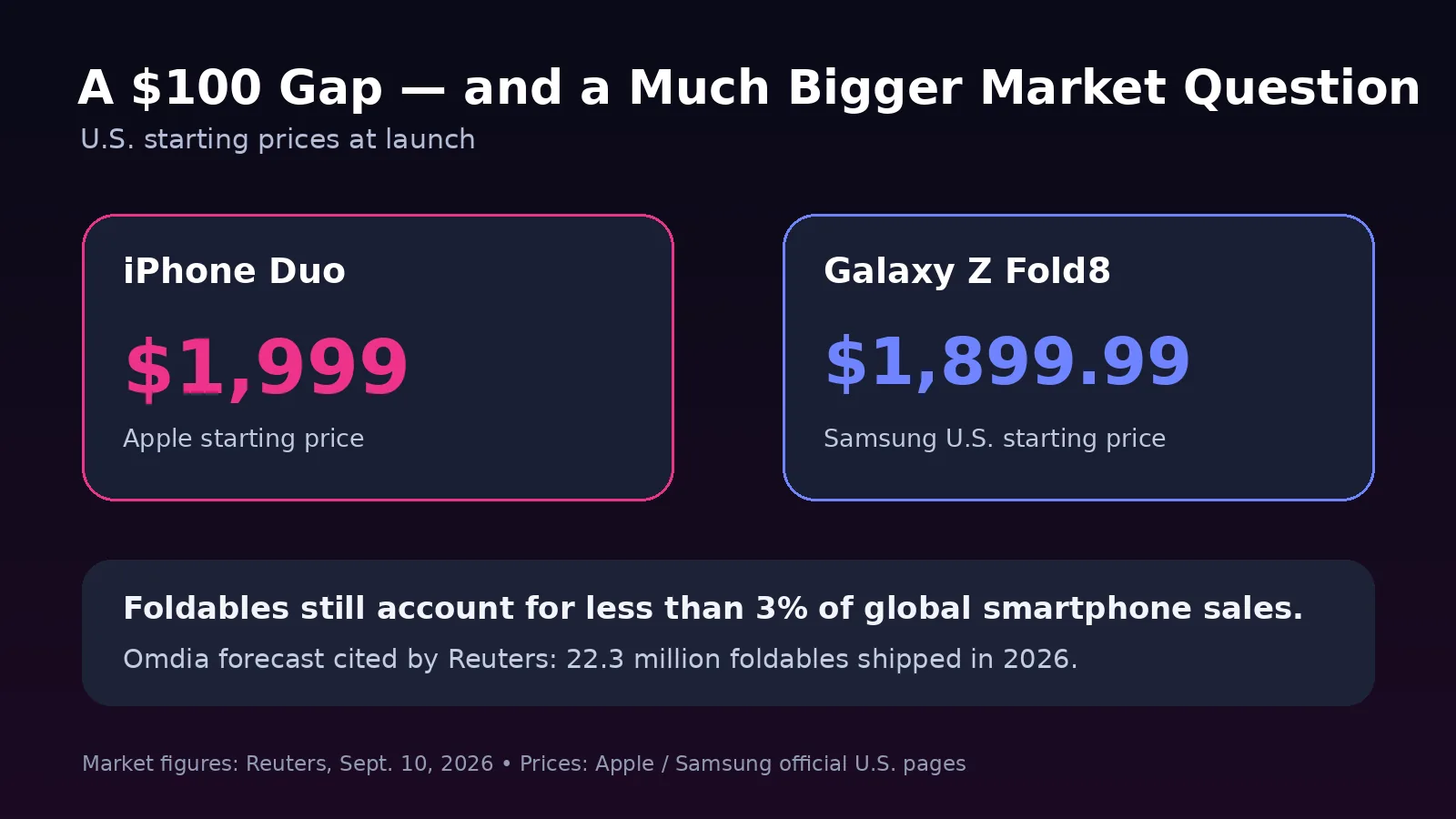
The bigger challenge is that both companies are still selling into a niche. Reuters reported on September 10 that foldables account for less than 3 percent of global smartphone sales, with Samsung holding roughly 40 percent of the segment. Omdia expects about 22.3 million foldable smartphones to ship in 2026. That is meaningful volume, but it is still small next to the broader smartphone market.
Apple's entrance could change the perception of the category even if the Duo itself remains expensive. A foldable iPhone puts the form factor in front of consumers who may never have seriously considered a Galaxy Fold, Huawei Mate or Honor Magic V. It also gives carriers, retailers, accessory makers and developers another reason to invest in the category.
Samsung's biggest advantage is experience
It would be a mistake to treat the Galaxy Z Fold8 as the old incumbent waiting to be disrupted. Samsung has already survived the difficult part of building a foldable business: early reliability criticism, awkward dimensions, thick bodies, app compatibility issues and years of consumer skepticism.
The Fold8 is the product of that learning curve. Samsung knows where foldable users complain, which software behaviors matter and which compromises can make an expensive device frustrating over time. That experience is difficult to compress into a first-generation product launch.
Samsung is also not ignoring Apple's arrival. Reuters reported that the company responded with a “Welcome to Foldables” campaign emphasizing its long history in the category. The tone is playful, but the competitive threat is serious: Apple is entering Samsung's most distinctive premium hardware category with a device priced close enough to force direct comparisons.
Apple's biggest advantage is ecosystem gravity
Apple does not need to prove that it can make every iPhone user buy a Duo. It needs to make enough people want one that the form factor becomes strategically important inside the Apple ecosystem.
If that happens, developers optimize for it. Accessory makers design for it. Enterprise software supports it. Services adapt around it. And once those changes exist, the Duo becomes more useful without Apple having to redesign the hardware every year.
That is why the impact of the iPhone Duo could be larger than its first-year sales. The device can push foldables from a hardware experiment into a software platform decision.
Which one looks stronger right now?
If the priority is proven foldable hardware, mature multitasking and years of platform-specific iteration, the Galaxy Z Fold8 has the clearer track record. Samsung has been refining this exact category since 2019 and the Fold8 reflects that experience.
If the priority is staying inside Apple's ecosystem, using iOS and gaining a foldable without abandoning iPhone-specific services and workflows, the Duo is immediately compelling in a way no Android foldable could be. Apple's matching screen ratios, iOS 27 adaptations and developer reach are potentially more important than any single specification.
Neither phone has “won” simply because of a launch presentation. The iPhone Duo still has to prove durability, battery behavior, app quality and daily ergonomics in real-world testing. The Fold8 still has to prove that years of experience are enough to stop Apple from rapidly capturing premium foldable buyers.
PhonesGate Verdict
The most important thing about the iPhone Duo is not that Apple finally made a folding phone. It is that the foldable category now has a true ecosystem war.
Samsung has the experience advantage. Apple has the ecosystem advantage. Samsung has spent eight generations proving the hardware can work; Apple now has to prove that iOS can make the form factor feel inevitable rather than optional.
For consumers, that competition is good news. It should accelerate better app layouts, thinner designs, stronger hinges, longer battery life and — eventually — lower prices. For the smartphone industry, the significance is even bigger: after years of incremental rectangle-versus-rectangle upgrades, the premium market finally has a form-factor battle that can change how people actually use their phones.
Apple did not invent the foldable. Samsung did not finish it. 2026 is the year the real fight begins.
Related PhonesGate coverage
Sources & methodology
This PhonesGate article is an original comparison and market analysis based on official product information and independent market reporting. Key sources:
- Apple Newsroom — iPhone Duo announcement, September 9, 2026
- Samsung Global Newsroom — Galaxy Z Fold8 first look, July 22, 2026
- Samsung US — Galaxy Z Fold8 product information and launch pricing
- Reuters — foldable market context, September 10, 2026
- Reuters — Samsung response to Apple's foldable launch, September 10, 2026