

Editor’s note: This is a PhonesGate first-look analysis based on Apple’s official September 9 announcement and independent launch coverage. The iPhone 18 Pro Max does not reach retail availability until September 18, so this is not a hands-on review. We will keep performance, camera and battery conclusions separate from manufacturer claims until independent testing is available.
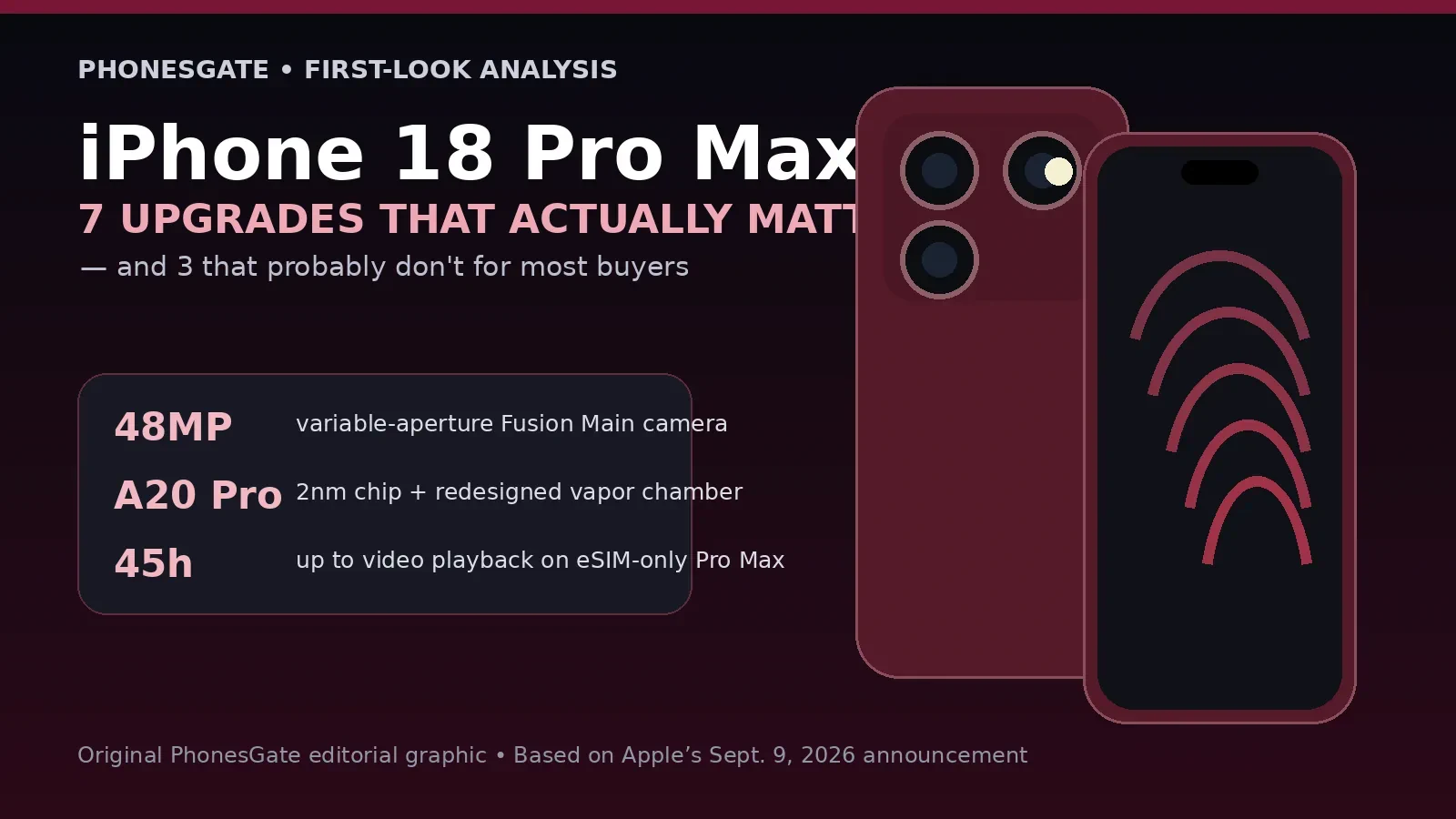
Apple’s iPhone 18 Pro Max is easy to dismiss as another familiar-looking Pro iPhone. The basic shape is still recognizably iPhone, the design language has not been reinvented, and the biggest changes are not obvious from across a room.
But underneath that familiar exterior, Apple has made several changes that could matter much more in daily use than a visual redesign would. The new 48MP Fusion Main camera introduces variable aperture to iPhone for the first time. A20 Pro moves to a 2-nanometer process. The vapor chamber has been substantially reworked. Battery life takes a major step forward, and iOS 27 arrives with a smaller Dynamic Island and the first rollout of Siri AI.
Key takeaway
The iPhone 18 Pro Max brings Apple’s first variable-aperture iPhone camera, A20 Pro, a redesigned thermal system, major battery gains and a smarter Dynamic Island. Here are the upgrades that should change daily use — and the ones most buyers can ignore.
The key question is not whether the specification sheet is longer. It is whether these changes make the phone meaningfully better for photography, sustained performance and all-day use.
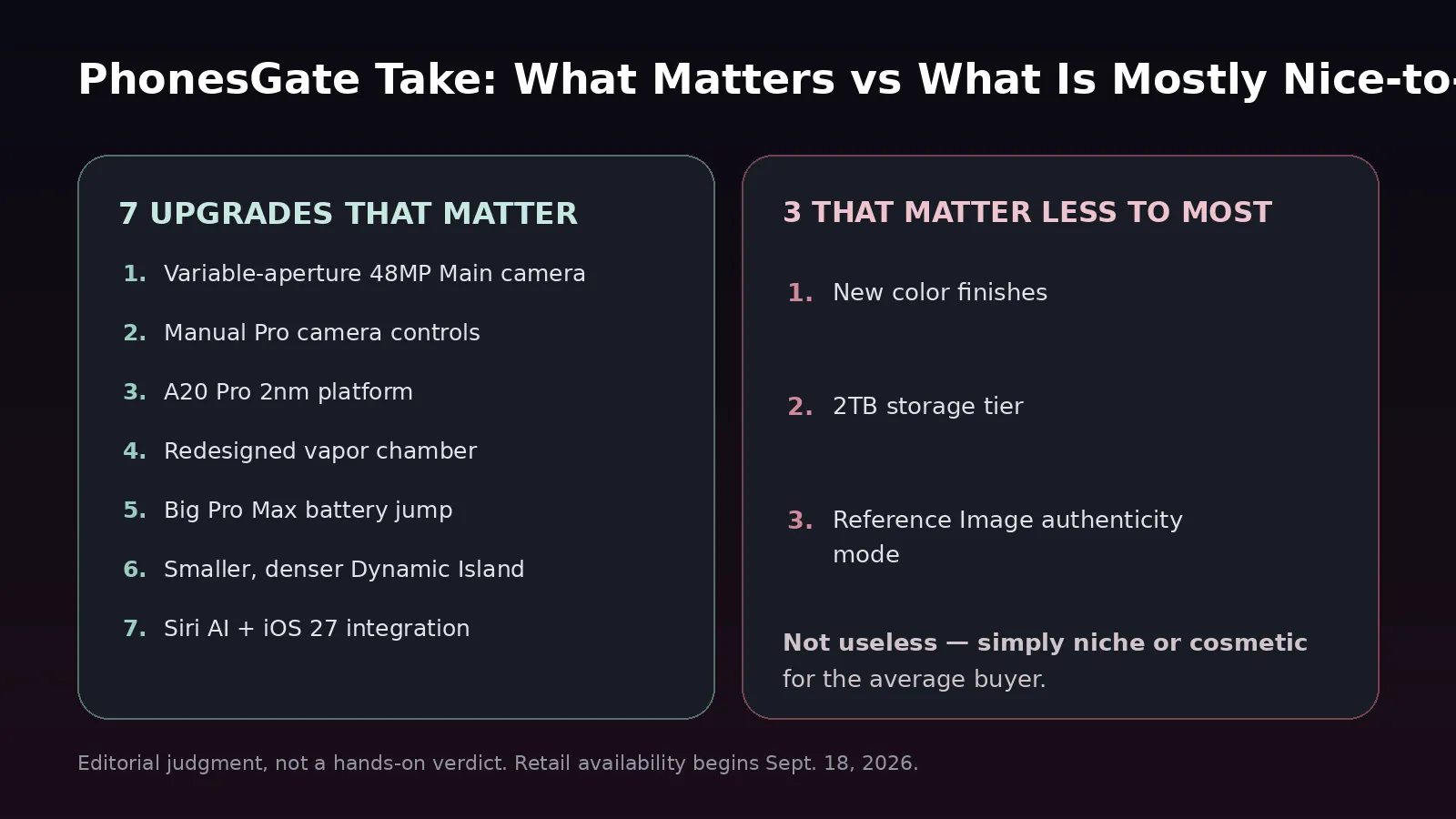
Here are the seven upgrades we think actually matter — followed by three additions that are useful or attractive, but probably should not decide whether you spend at least $1,299 on Apple’s new flagship.
10 min read
Apple coverage from PhonesGate. Published Sep 12, 2026.
1. Variable aperture is the camera upgrade iPhone needed
The headline change is the new 48MP Fusion Main camera with variable aperture. Apple says a six-blade mechanism can automatically change the lens opening according to lighting and desired depth of field. Users can also select among four aperture settings manually in the Camera app.
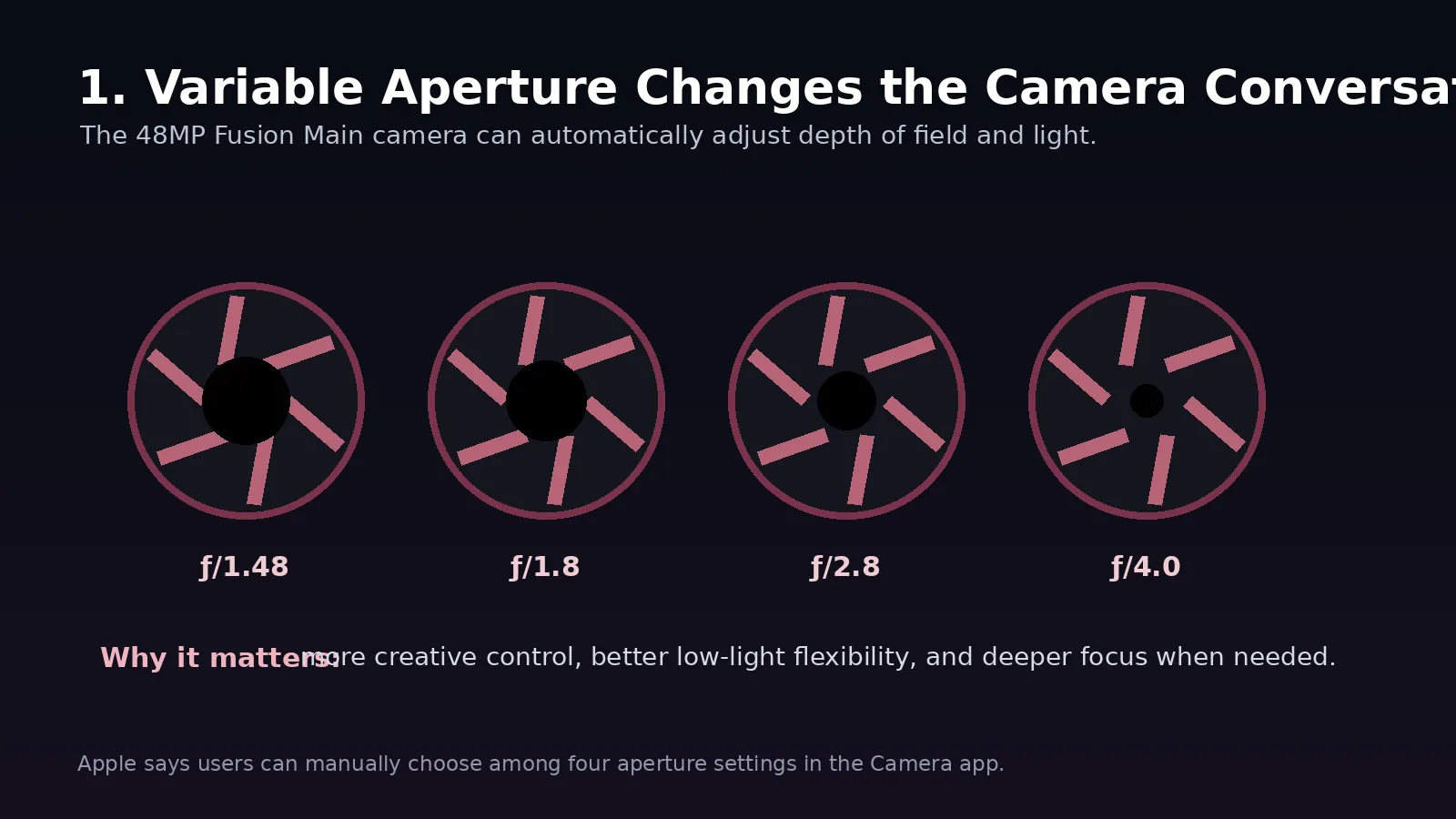
This matters because aperture is not just another number for the spec sheet. A wider opening can gather more light when conditions are poor. A narrower opening can keep more of a scene in focus — useful for group photographs, landscapes and situations where the background should remain sharp rather than dissolve into blur.
Apple says the main camera can open to ƒ/1.48 for low-light scenes, use ƒ/1.8 for portraits and narrow to ƒ/4 when more depth of field is needed. Independent launch coverage also reports four selectable stops in total.
The important distinction is that the 18 Pro Max is no longer relying exclusively on computational photography to imitate every creative decision after capture. Apple is adding a genuinely physical control to the optical system. For photographers, that is potentially the most meaningful iPhone camera change in years.
2. Pro Controls make the Camera app less restrictive
Variable aperture would be much less useful if Apple buried it behind automation. Instead, the company is introducing a customizable Pro Controls interface inside the native Camera app.
Apple says users can manually adjust aperture, shutter speed and white balance, while a histogram can be used to monitor exposure. The new computational imaging pipeline is also designed to produce more detailed images from the Main camera, while Photographic Styles gain texture and grain controls.
Video receives meaningful additions too. Cinematic effects can be applied after capture to compatible footage shot at up to 60 fps, while Time-lapse can now be recorded in 4K with Dolby Vision HDR.
For years, serious iPhone shooters often relied on third-party apps when they wanted deeper manual control. The 18 Pro generation does not eliminate the need for specialized camera software, but Apple is finally acknowledging that a “Pro” camera should let the user override more of the automation.
3. A20 Pro matters because Apple is changing more than peak speed
Apple’s new A20 Pro is manufactured on a 2-nanometer process and includes a six-core CPU, seven-core GPU and Dual 16-core Neural Engine. Apple claims 50 percent more memory bandwidth than A19 Pro and up to 40 percent faster GPU performance compared with the previous chip.
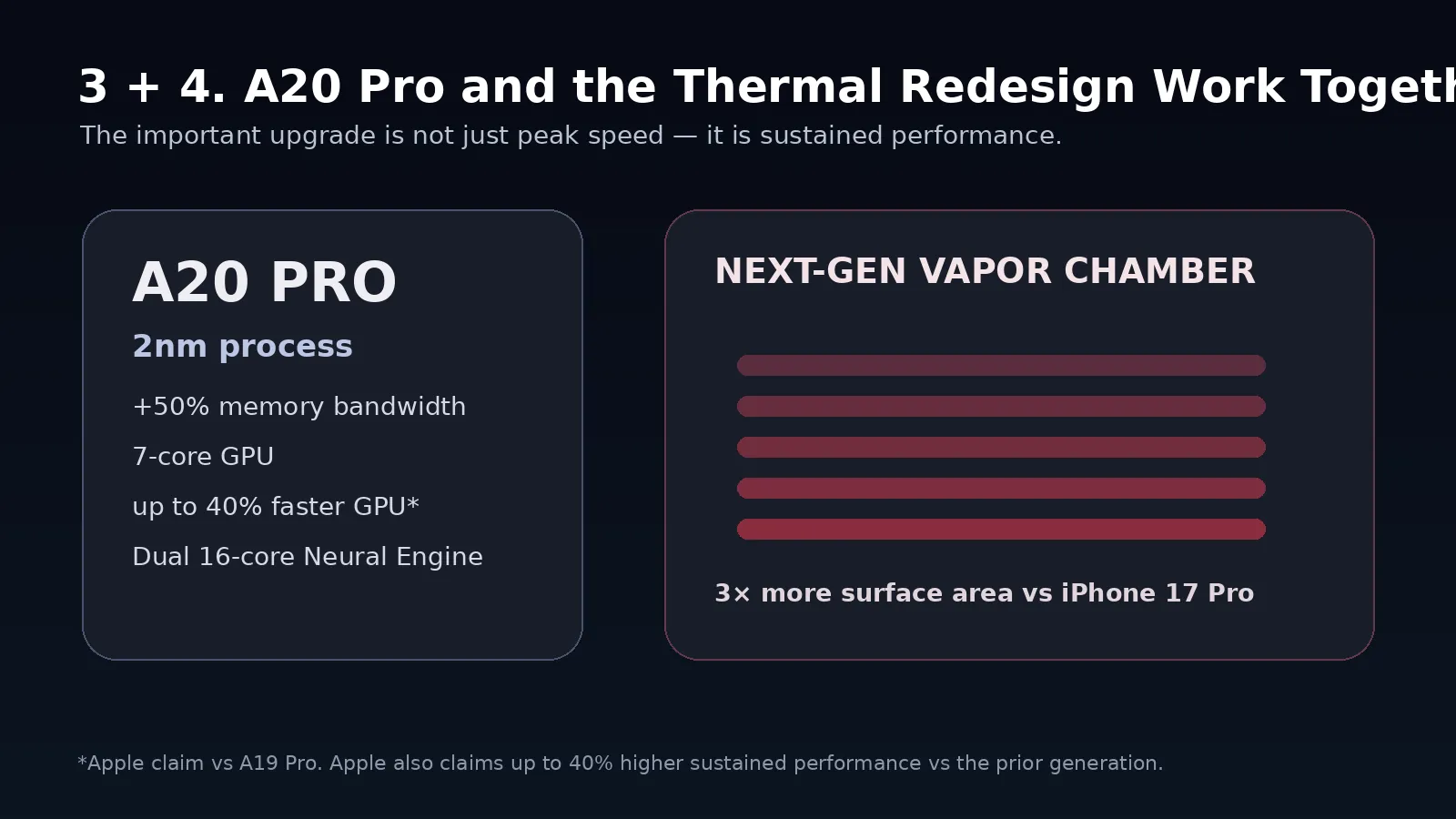
Those numbers are impressive, but “faster chip” is not by itself a compelling reason to replace a recent flagship. The more interesting part is what Apple has changed around the silicon.
A20 Pro uses packaging inspired by Apple’s M-series chips, placing the silicon die beside the memory and allowing the chip to attach directly to a redesigned vapor chamber. That suggests Apple is targeting a problem that affects gaming, video work and heavy AI processing: performance that starts fast but falls as heat builds up.
4. The redesigned vapor chamber could be more important than benchmarks
Apple says the new vapor chamber uses different materials and has three times more surface area than the system in iPhone 17 Pro. The company claims the combination can deliver up to a 40 percent gain in sustained performance versus the previous generation.
That claim still needs independent thermal testing. But the direction is exactly right. A flagship phone does not need to win a benchmark for thirty seconds; it needs to maintain useful performance during a long gaming session, a large video export, camera processing or a sustained AI workload without becoming uncomfortable or aggressively throttling.
If Apple’s sustained-performance figure holds up under real-world testing, this could be one of the upgrades owners notice over several years rather than only during launch week.
5. Pro Max battery life takes a major step forward
Battery life may be the least glamorous upgrade here, but for most buyers it could have the largest everyday impact.
Apple says eSIM-only versions of the iPhone 18 Pro Max can deliver up to 45 hours of video playback. The company also cites up to 30 hours of usage on a full charge under its newer battery-usage model. Apple says five minutes of wired charging can provide roughly seven hours of video playback on the Pro Max.
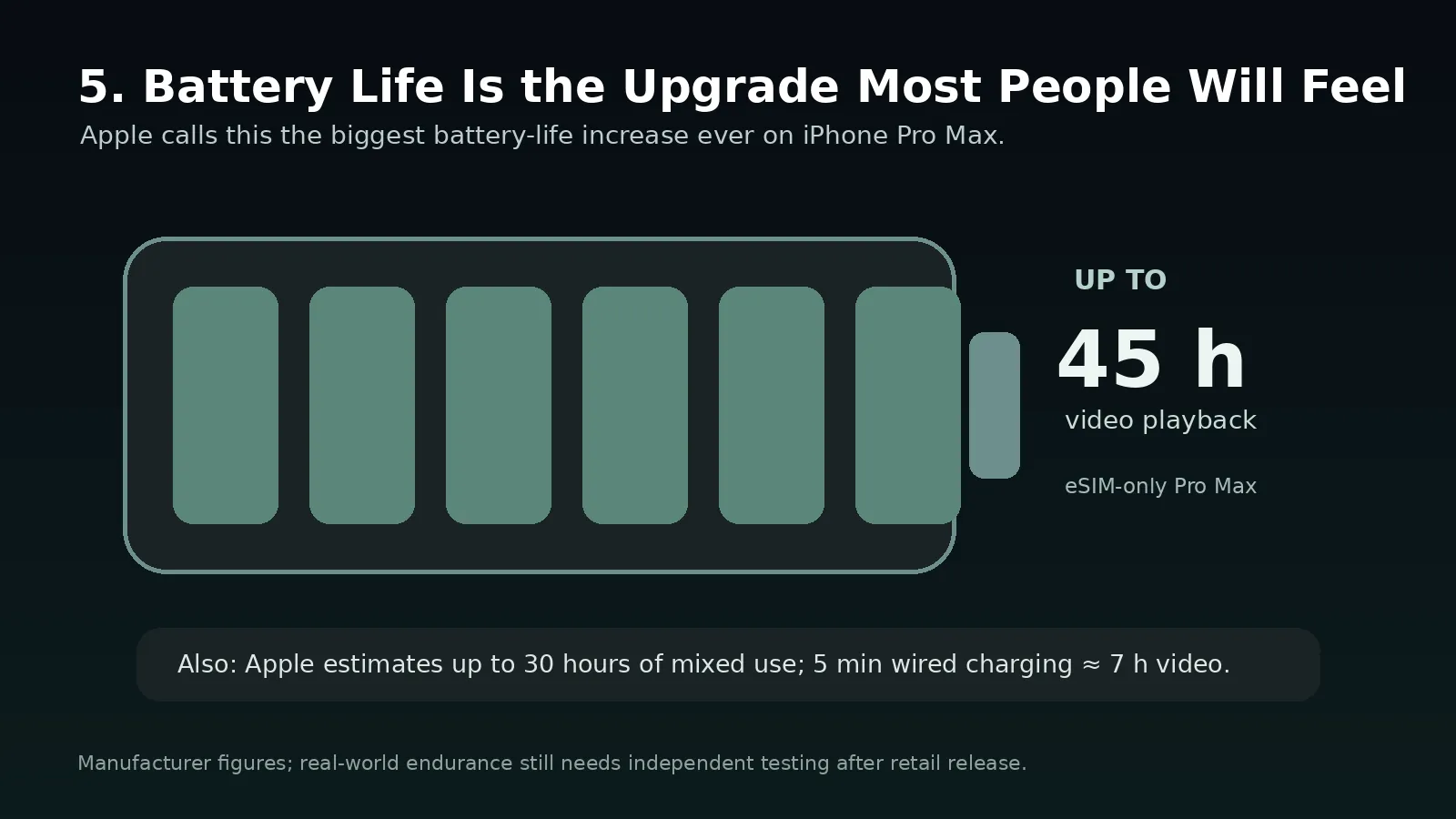
There is an important regional detail: Apple says eSIM-only models use the physical-SIM space for a larger battery and gain two additional hours of video playback. That means battery specifications may differ depending on the market.
This is also why we would not publish a “battery winner” verdict before retail testing. Screen brightness, cellular conditions, camera use, gaming, navigation and AI workloads can produce very different results from controlled playback tests. Still, Apple calling this the largest battery-life increase ever on iPhone Pro Max makes it one of the first things we would test.
6. The smaller Dynamic Island is finally doing more with less space
Apple has redesigned the Dynamic Island so it occupies less visual space while showing more information. On iPhone 18 Pro models, Apple says it can display up to three Live Activities at once while continuing to house the Face ID system.
This is not the kind of feature that sells a $1,299 phone by itself. But it is a good example of an upgrade that improves something users interact with repeatedly throughout the day. Navigation, timers, deliveries, sports scores, rides and other ongoing activities can coexist without requiring the Dynamic Island to dominate more of the display.
The improvement also feels more credible than simply making the cutout smaller for aesthetic reasons. Apple is using the recovered space to increase information density.
7. Siri AI and iOS 27 finally make the AI hardware relevant
Apple Intelligence has been part of the iPhone story for several generations, but iOS 27 pushes it further with Siri AI. Apple says the new Siri can use personal context across messages, email and photos, understand what is currently on screen and take actions related to that content.
The Camera app also gets a Siri mode that can provide information or actions based on what the camera is seeing. Other iOS 27 features include Spatial Reframing, Extend and an upgraded Clean Up for photos, plus a Safari Notify Me feature designed to watch pages for changes such as restocks or price drops.
There is a major caveat: Siri AI is launching in beta and availability varies by language and region. Apple says the initial September 14 beta rollout targets supported devices set to English, with additional languages following later. So this is a meaningful platform upgrade, but not every buyer will receive the same experience on day one.
Three iPhone 18 Pro Max upgrades that matter less to most buyers
1. The new colors
Black, silver, glacier and the new burgundy finish give buyers more choice, and burgundy is visually distinctive. But a finish is still cosmetic. Once the phone is in a case, the most important parts of the upgrade remain camera, battery, performance and software.
2. The 2TB storage option
Apple now offers 256GB, 512GB, 1TB and 2TB configurations. Two terabytes is useful for professionals who capture large volumes of high-resolution video or keep extensive media libraries locally. For typical users, it is a niche configuration rather than a reason to choose the 18 Pro Max.
3. Apple Reference Image — important, but specialized
Apple Reference Image is technically fascinating. In the new Reference mode, Apple says the camera can capture signed sensor data and create an unalterable reference image that can later be compared with an edited version. Apple positions the feature as part of a broader push toward image authenticity.
For photojournalists, investigators, creators dealing with provenance or anyone who needs to demonstrate that an image has not been manipulated, that could become genuinely valuable. For the average buyer taking family photos and holiday shots, it is unlikely to influence the purchase decision.
Should iPhone 17 Pro Max owners upgrade?
This is where Apple has the hardest sell.
If you already own an iPhone 17 Pro Max, the 18 Pro Max does not represent a radical change in form factor. The upgrade makes the most sense if one of three things is important to you: camera control, sustained heavy performance or maximum battery endurance.
Photographers and video creators have the clearest reason to look closely because variable aperture and native Pro Controls change how the camera can be used rather than simply improving an existing mode. Gamers and heavy creators should watch independent thermal testing because the vapor-chamber redesign could be significant. Frequent travelers and power users may value the battery gains more than any benchmark score.
Everyone else should wait for real-world tests before upgrading from a one-year-old flagship.
Who is the iPhone 18 Pro Max really for?
At a U.S. starting price of $1,299 for 256GB, the Pro Max is not positioned as the default iPhone. It is a premium device for buyers who specifically value the largest endurance envelope, Apple’s highest-end camera system and sustained performance.
Pre-orders opened on September 12, 2026, with retail availability scheduled for September 18. That timing matters for our verdict: early impressions can tell us how the camera controls feel and whether the smaller Dynamic Island is useful, but battery, thermal behavior and camera consistency need more time.
That distinction is especially important for PhonesGate. A specifications database can tell you what hardware exists. Editorial coverage should tell you which parts of that hardware are likely to matter — and be transparent about what has not yet been verified through independent testing.
PhonesGate verdict
The iPhone 18 Pro Max looks like a much more meaningful upgrade than its familiar exterior suggests.
The variable-aperture camera is the standout because it adds genuine optical flexibility rather than another software-only photography mode. A20 Pro becomes more interesting when paired with a substantially redesigned thermal system. The battery claims are unusually aggressive, and the smaller Dynamic Island is a sensible refinement rather than design change for its own sake.
The features we would not use to justify an upgrade — new colors, 2TB storage and Reference Image for mainstream buyers — are not bad additions. They simply serve narrower audiences.
If Apple’s battery and sustained-performance claims survive independent testing after September 18, the 18 Pro Max could be one of the strongest “under-the-surface” Pro upgrades in recent years.
For full specifications, storage options, camera details and connectivity information, see the PhonesGate iPhone 18 Pro Max device page.
Sources and methodology
This article is original PhonesGate analysis. Product claims were checked against Apple’s official launch material and are clearly identified as manufacturer claims where independent testing is not yet available.