


Google’s Dialogues stage at I/O 2026 assembled company executives, researchers and creative professionals to examine how emerging technologies will affect productivity, science, and the arts. The sessions paired Google leaders with external voices to break down the practical and speculative implications of recent developments.
Source and context
The Dialogues stage featured conversations led by Google figures alongside guests from media, research and industry. Panels were organized around major themes highlighted during I/O: the rise of proactive AI agents, intersections between quantum computing and AI, robotics advances in embodied intelligence, and AI-assisted creative workflows for film and storytelling.
Notable panels and participants
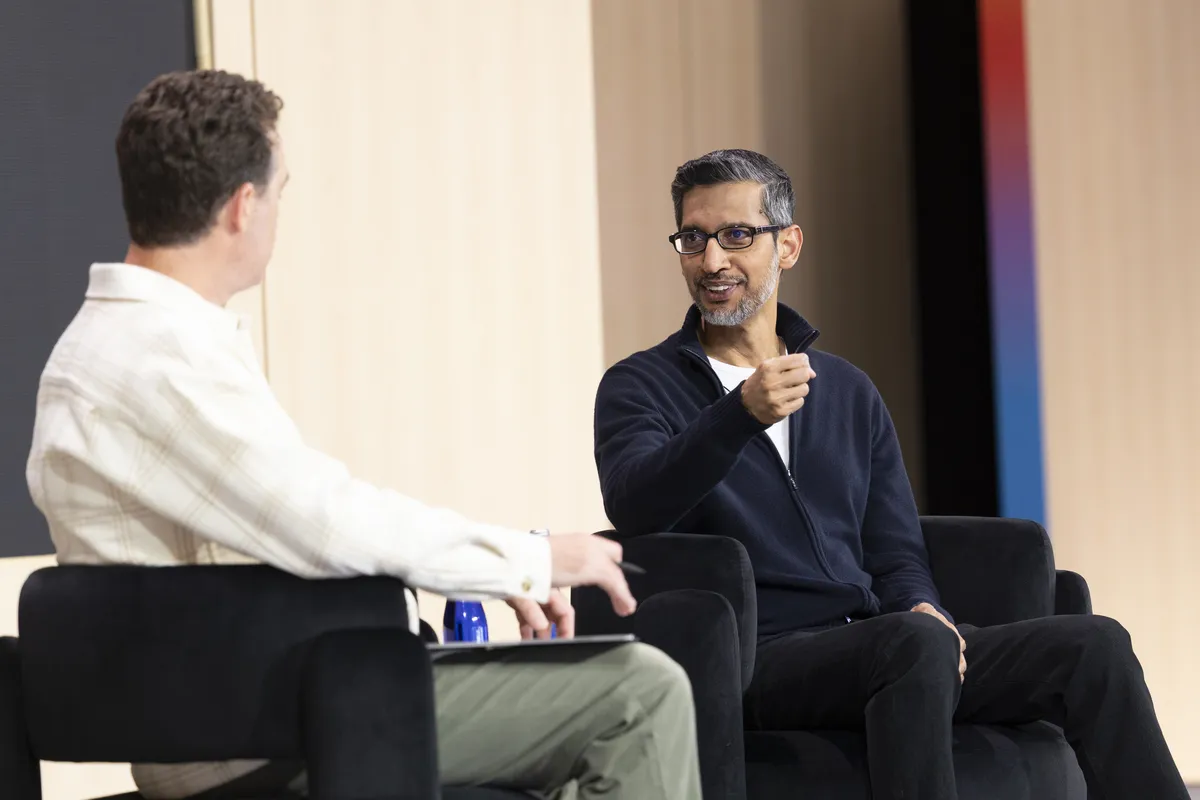
Google CEO Sundar Pichai sat down with Matt Berman, creator and founder of Future Forward, to expand on the vision behind I/O’s headline announcements. A session on AI agents brought together Google researchers Josh Woodward, Koray Kavukcuoglu, Liz Reid, and Jeff Dean, moderated by Logan Kilpatrick, to discuss how proactive agents are changing productivity paradigms.
Key takeaway
At I/O 2026 Google’s Dialogues stage gathered company leaders, scientists and creators to discuss how breakthroughs in AI, quantum computing, robotics and storytelling are shaping technology’s next steps.
On the technical front, Google’s Hartmut Neven and James Manyika explored the intersection of quantum computing and AI, discussing potential crossovers between the two fields. DeepMind CEO Demis Hassabis spoke with Axios’ Mike Allen about AI’s role in tackling complex scientific problems, highlighting the research and application angle.
Robotics was represented by Google DeepMind’s Kanishka Rao and Boston Dynamics’ Alberto Rodriguez, who discussed recent advances in embodied physical AI and the implications for real-world tasks and automation. The creativity panel featured director Doug Liman alongside Jed Weintrob and Julina Tatlock from 30 Ninjas in conversation with Google’s Mira Lane on how AI is being used to push cinematic storytelling boundaries.
3 min read
Google coverage from PhonesGATE. Published Jul 17, 2026.
Why this matters
The Dialogues stage provided a focused look at how research and industry leaders are translating ambitious technical advances into practical tools and creative practices. Topics such as proactive AI agents and embodied robotics point to systems that will increasingly act autonomously or semi-autonomously in support of human work. The quantum and science discussions underscore ongoing exploration of foundational technologies that could enable new classes of computation and discovery.
PhonesGATE quick analysis
The Dialogues sessions reflect a mature effort to frame new capabilities for public and developer audiences. Emphasis on agents and embodied AI signals priority areas where consumer devices, cloud services, and robotics could converge. The creativity-focused conversations indicate continued industry interest in tools that augment — rather than replace — human creative processes.
What this means for buyers
For consumers and professionals, these conversations suggest incremental change more than abrupt disruption: expect features driven by agent-like assistance to appear first in cloud-backed services and device software updates. Robotics and quantum advances are likely to influence specialized markets and research before becoming mainstream consumer-facing products. Creatives should watch for new tools that speed workflows and open new creative possibilities while still requiring human direction.
Related device context
Readers tracking how these themes affect hardware and services may want to follow developments in flagship Android devices, Google’s Pixel line, and cloud AI tools that enable agent capabilities and on-device ML enhancements.
Sources and methodology
This article is based on reporting from Google AI, with PhonesGATE editorial context and buyer-focused analysis.