

Huawei is no longer treating the foldable phone as a single-hinge experiment. With the Mate XT2, the company is doubling down on a tri-fold design that can behave like a conventional phone when closed, a larger multitasking device when partially opened, and something much closer to a compact tablet when fully unfolded.
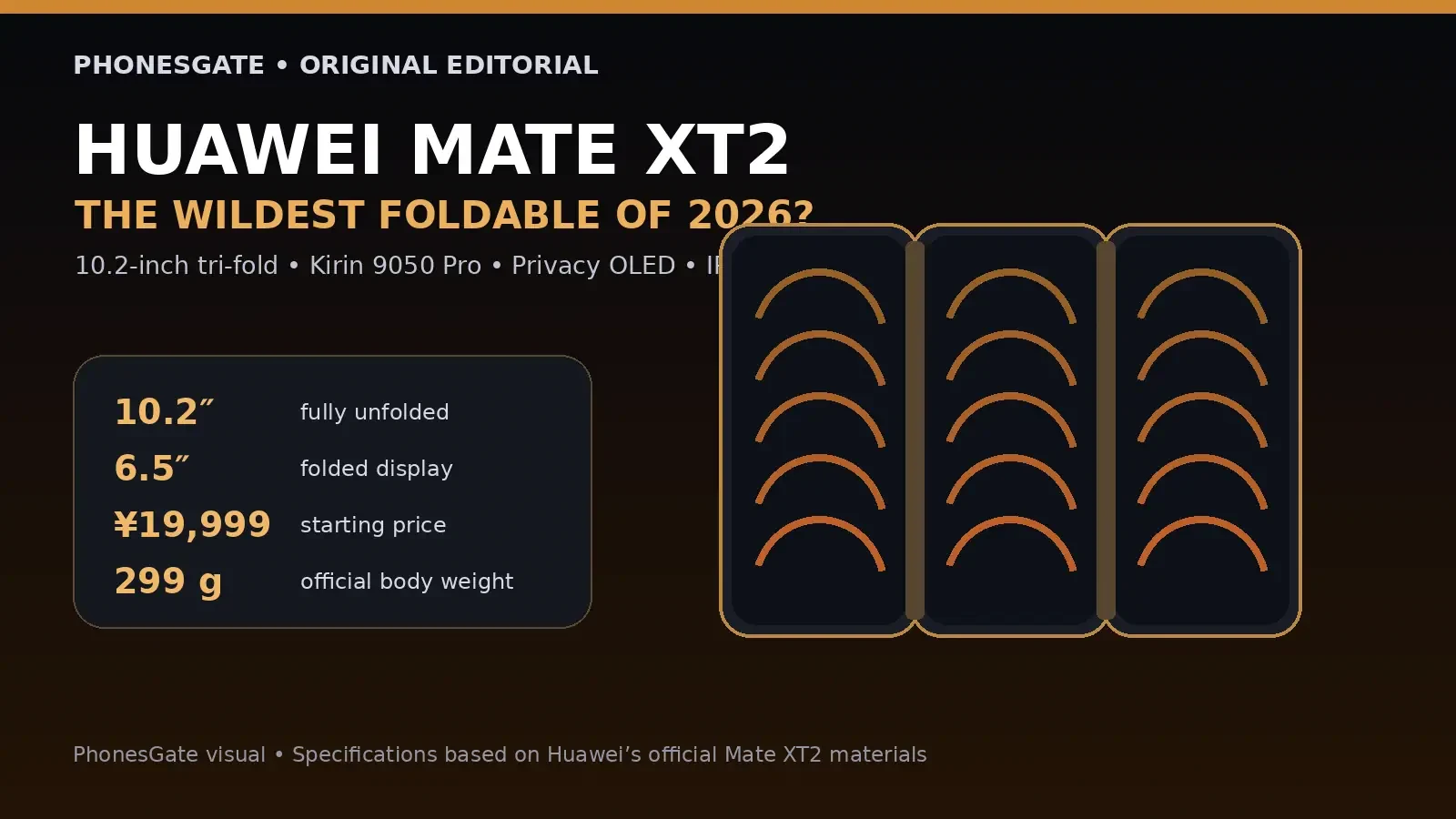
That alone makes the Mate XT2 one of the most technically ambitious smartphones of 2026. But the bigger story is not simply that Huawei added another fold. The new model combines a 10.2-inch tri-fold OLED, Kirin 9050 Pro, optional privacy-display technology, IP58/IP59 protection and a redesigned hinge system in a body that Huawei says weighs roughly 299 grams before the screen surface layer is counted.
It is also extremely expensive. The Mate XT2 starts at 19,999 yuan in China, which puts it firmly in halo-product territory. Reuters reported that sales begin September 12. That means the phone is less about replacing the average flagship and more about showing how far Huawei thinks the foldable category can go.
Key takeaway
Huawei’s Mate XT2 pushes foldables beyond the usual book-style design with a 10.2-inch tri-fold OLED, Kirin 9050 Pro, optional privacy display and IP58/IP59 protection. At 19,999 yuan, it is a halo product — but it may show where foldables go next.
And in a year when Apple has entered foldables with the iPhone Duo and Samsung continues refining the Galaxy Z Fold line, Huawei's approach looks deliberately different.
The Mate XT2 does something normal foldables cannot
A book-style foldable gives you two basic states: closed and open. The Mate XT2 adds a third physical panel and therefore a more flexible continuum between phone and tablet.
7 min read
PhonesGate coverage from PhonesGate. Published Sep 13, 2026.
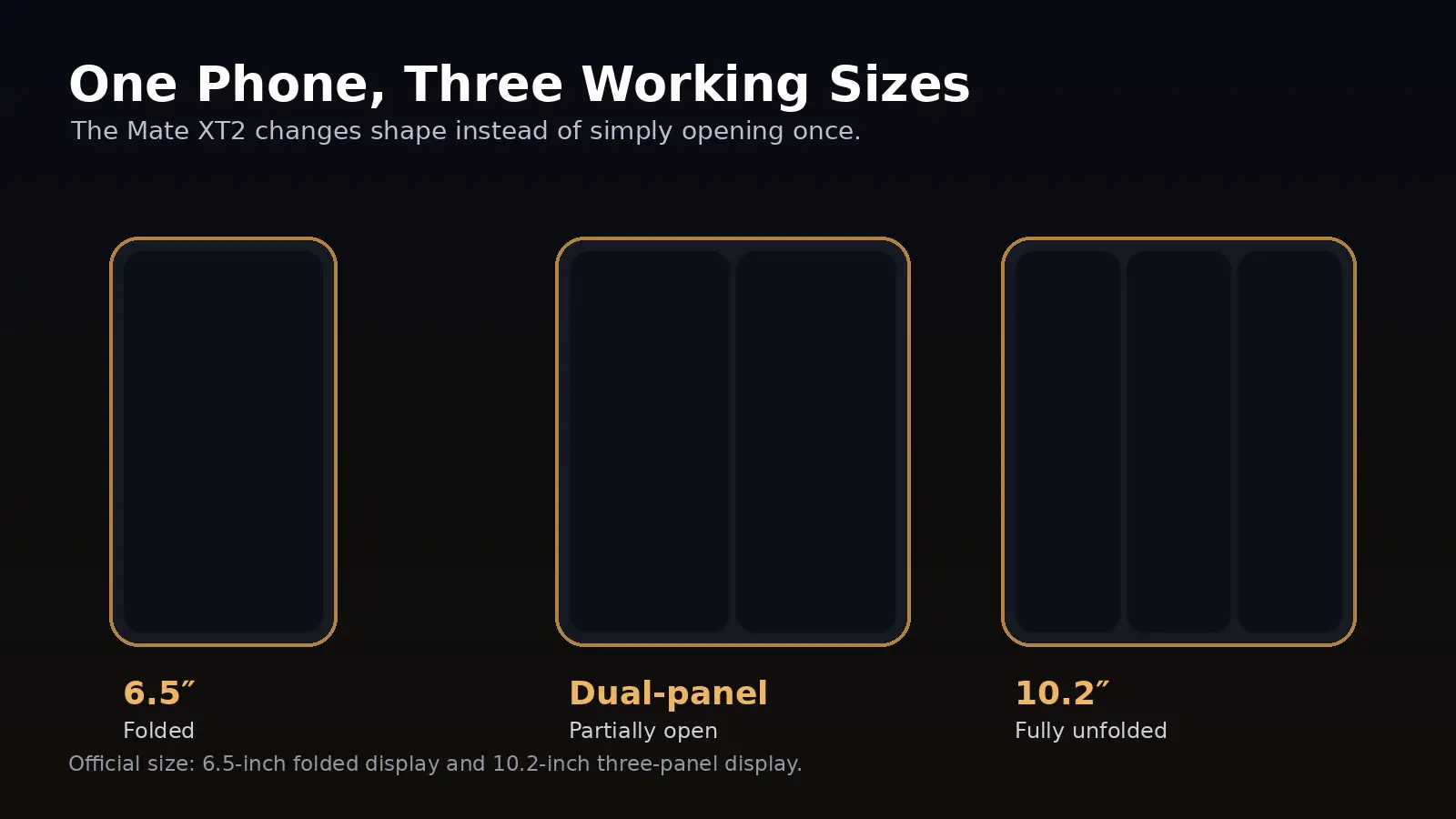
Huawei lists the display at 6.5 inches when folded and 10.2 inches when fully opened. The unfolded resolution is 2232 × 3184, while the folded display runs at 2442 × 1140. The outer display supports a 1–120Hz LTPO refresh rate; the standard inner panel uses up to 90Hz, while the privacy-screen version can run up to 120Hz.
The important point is usability. A 10.2-inch panel is large enough to change how the device can be used. Documents, spreadsheets, side-by-side apps, video playback and web browsing can all benefit from the extra canvas in a way that a normal 7.6-inch book-style foldable cannot fully replicate.
The trade-off is obvious: tri-fold hardware is mechanically more complicated. More hinges, more flexible screen area and a wider unfolded structure create additional durability, weight and thermal-management challenges.
The optional privacy OLED is the feature nobody expected
One of the most unusual Mate XT2 options is Huawei's Lingxi privacy screen. Rather than relying only on a dark software overlay, Huawei says the panel uses an independent dual-pixel design that can switch from a wide viewing mode to a narrower viewing mode.
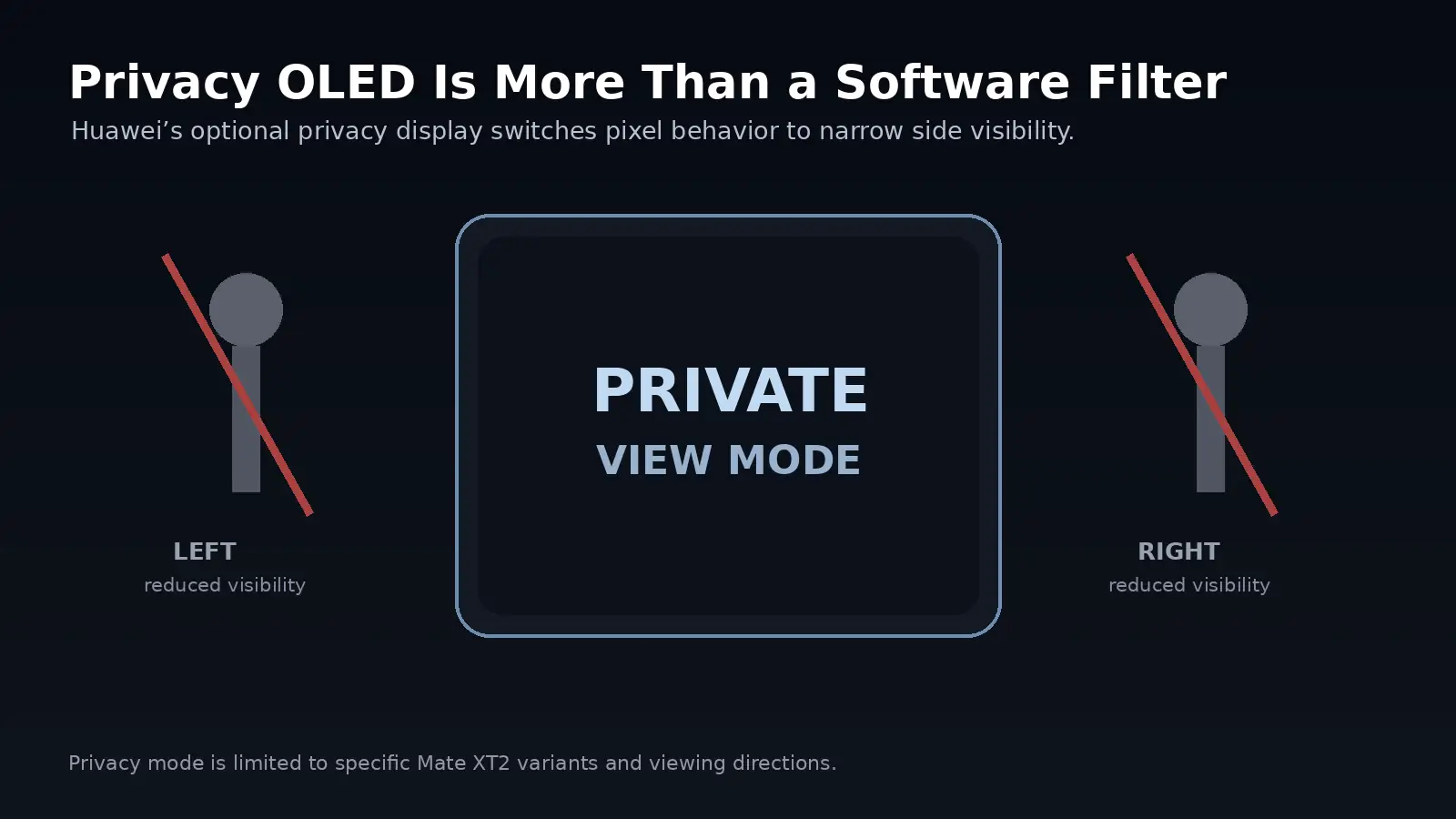
The idea is simple: when privacy mode is enabled, the person directly in front of the display should retain a clear image while people looking from the side see much less. Huawei says resolution remains unchanged when the mode is active.
This makes unusual sense on a tri-fold. A 10.2-inch screen is much easier for nearby passengers or coworkers to see than a conventional phone display. Huawei specifically highlights airports, trains and other crowded environments as use cases.
There are limitations. Huawei notes that the USB-port side of the phone does not receive the same privacy protection, so viewing direction still matters. And the feature is limited to specific Mate XT2 configurations.
Huawei is trying to solve the tri-fold durability problem
A tri-fold phone sounds impressive on a launch stage, but the real engineering challenge begins after thousands of open-and-close cycles.
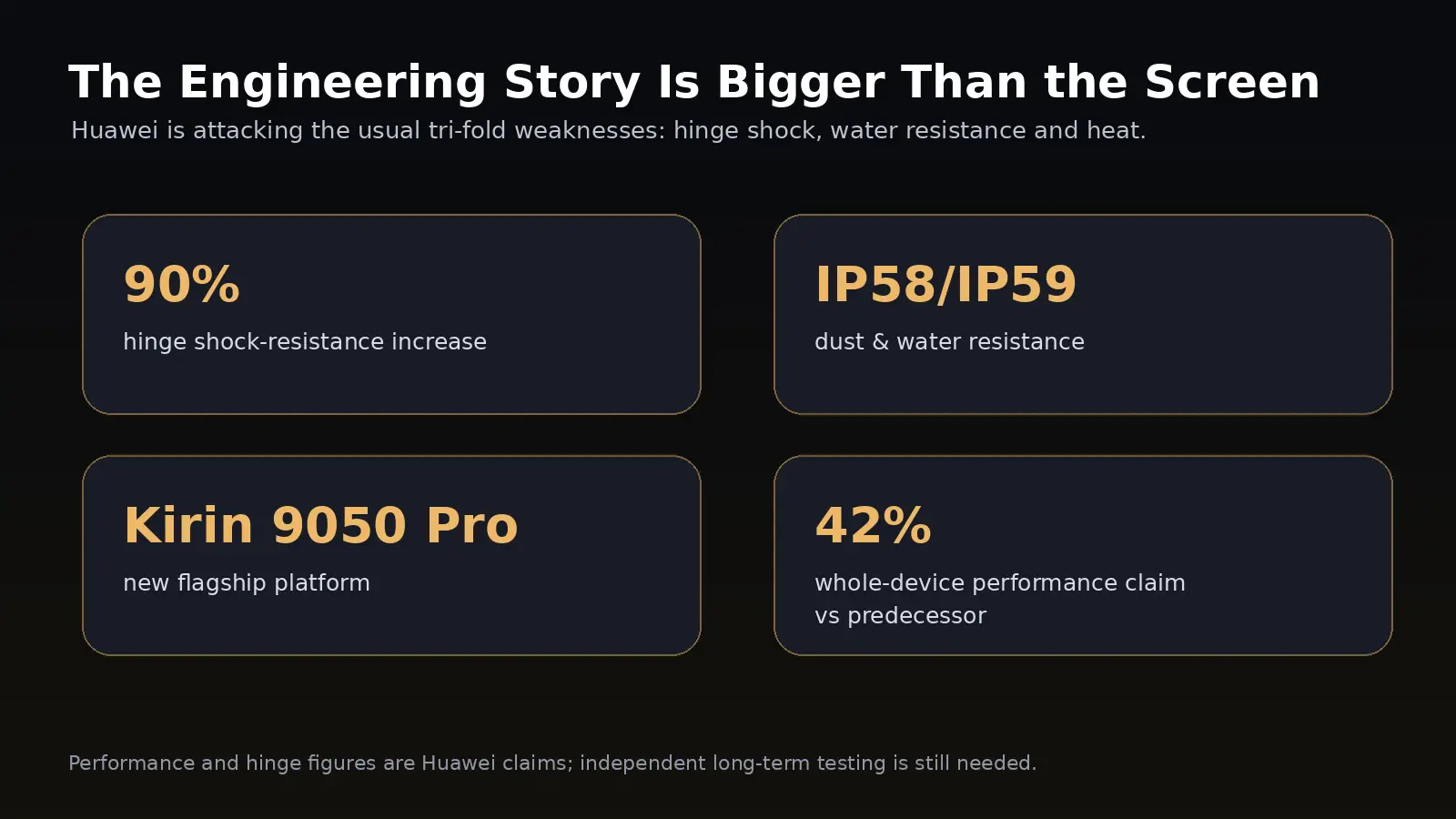
Huawei says the new hinge system improves shock resistance by 90% compared with the previous generation. The Mate XT2 also carries IP58 and IP59 dust- and water-resistance ratings, an important upgrade for a device with multiple hinges and such a large flexible display.
The body measures 157.2mm tall and 77mm wide when folded. Huawei lists folded thickness at 12.3mm, while the three unfolded sections range from 3.5mm to 4.0mm depending on where the camera hardware sits.
At around 299 grams — or roughly 304 grams including the screen surface layer, according to Huawei's own footnote — this is not a light phone. But considering that it unfolds into a 10.2-inch screen, the number also highlights just how aggressively Huawei has packaged the hardware.
Kirin 9050 Pro is about more than benchmark numbers
The Mate XT2 debuts Huawei's Kirin 9050 Pro and HarmonyOS 7. Huawei describes the chip as part of its “LogicFolding” strategy and claims whole-device performance is up 42% compared with the previous Mate XT generation.
Those numbers should remain manufacturer claims until there is broader independent testing. What is more interesting is how Huawei designed the thermal system around the tri-fold chassis.
The company says major heat sources are distributed across the three frame sections rather than concentrated in one area. The phone also uses a large vapor chamber and high-conductivity graphene. That approach is necessary because a tri-fold chassis changes where heat can travel when the device is opened and closed.
The camera hardware is flagship-grade on paper
Huawei did not turn the Mate XT2 into a screen-first device with compromised cameras. The main camera uses a 50MP RYYB sensor with OIS and continuous variable aperture from f/1.49 to f/4.0. It is joined by a 40MP RYYB ultra-wide camera and a 50MP RYYB periscope telephoto with OIS.
The phone also includes Huawei's third-generation Red Maple color system, intended to improve color capture and consistency.
At 19,999 yuan, the Mate XT2 is not trying to be normal
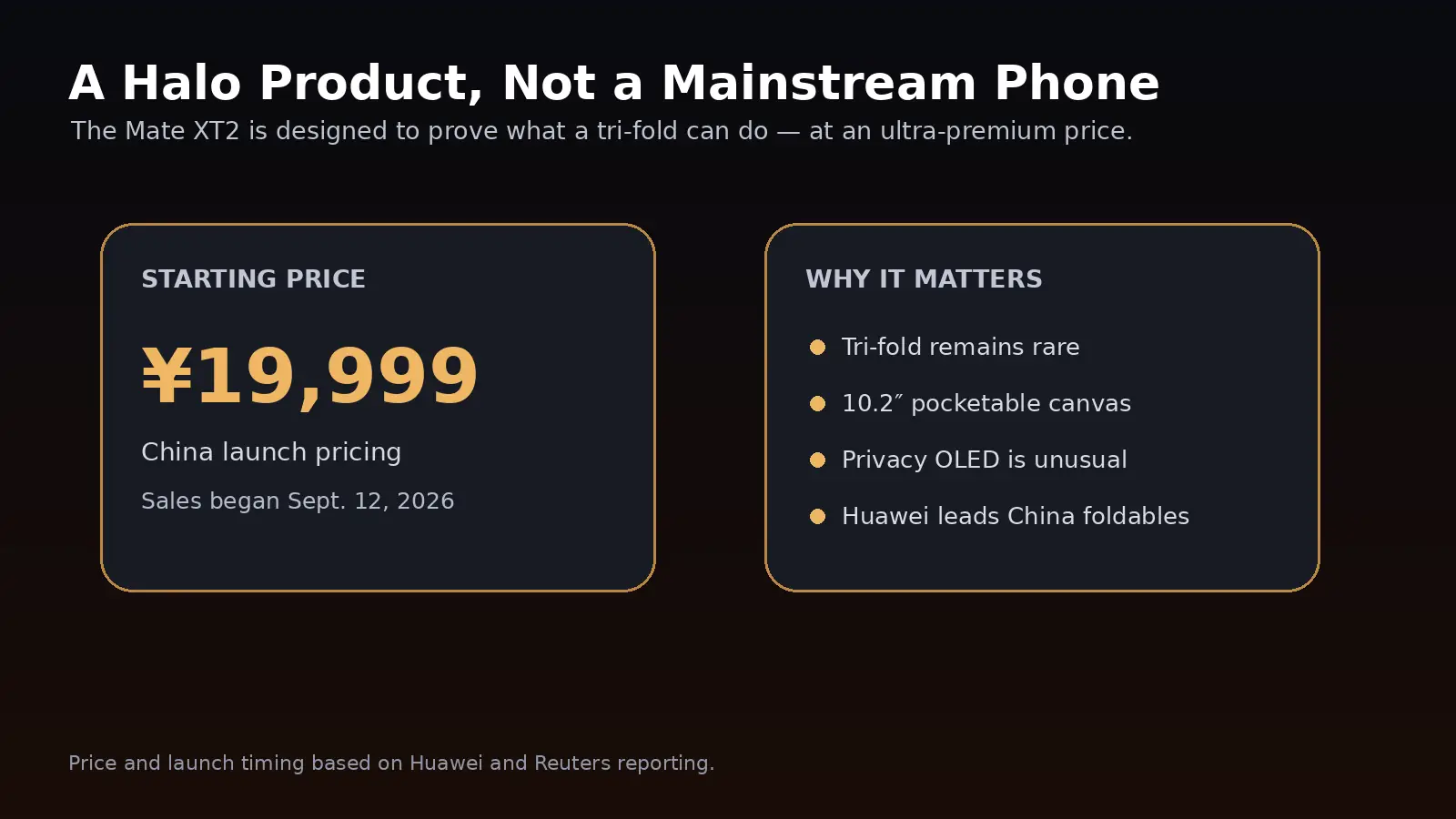
The starting price immediately tells you what kind of product this is. At 19,999 yuan, Huawei is not chasing mass-market volume with the XT2.
That actually gives the company more freedom. A halo product can prioritize engineering ambition over conventional value. It can experiment with a form factor that would be too risky for a mainstream flagship and then let the useful ideas trickle down later.
Why the XT2 matters in the Apple and Samsung era
The timing is what makes the Mate XT2 particularly interesting.
Apple has now entered the foldable market with the iPhone Duo, choosing a relatively conservative book-style layout. Samsung is already eight generations deep into the Galaxy Z Fold line. Huawei is doing something else entirely: using the foldable category as a place to experiment with form factors that go beyond the standard two-panel design.
Reuters reported that Huawei controls a major share of China's foldable market, while Samsung remains the global foldable leader. Apple's arrival will put more pressure on both companies to differentiate.
For Huawei, the tri-fold itself is differentiation.
But does a tri-fold actually make sense?
There are legitimate reasons to be skeptical.
A tri-fold is heavier. It is mechanically more complicated. Replacing a damaged flexible panel is unlikely to be cheap. The phone is extremely expensive, and its availability is far more limited than mainstream Apple or Samsung devices.
There is also the software question. A 10.2-inch canvas is only valuable if apps and multitasking interfaces use it properly. Huawei's HarmonyOS 7 gives the company more control over that experience, but software optimization will determine whether the third panel feels essential or merely impressive.
And then there is durability. Huawei's 90% hinge-resistance improvement and IP58/IP59 ratings are encouraging, but a device like this needs months of real-world use before anyone can confidently call it proven.
PhonesGate verdict
The Mate XT2 is probably not the foldable most people should buy. That is also why it may be one of the most important foldables of 2026.
Apple is trying to make foldables feel mainstream. Samsung is trying to perfect the book-style formula. Huawei is asking what happens after that formula.
The 10.2-inch tri-fold display gives the XT2 a genuinely different use case. The optional privacy OLED is unusually practical for such a large portable screen. The camera hardware looks serious, and the IP58/IP59 protection suggests Huawei understands that futuristic hardware still needs everyday resilience.
The price is extreme, the weight is high and long-term durability remains the biggest unanswered question. But the XT2 proves something important: the foldable category is not finished evolving.
If normal foldables are becoming predictable, Huawei just made the category weird again — and that is exactly what smartphone design needs.