

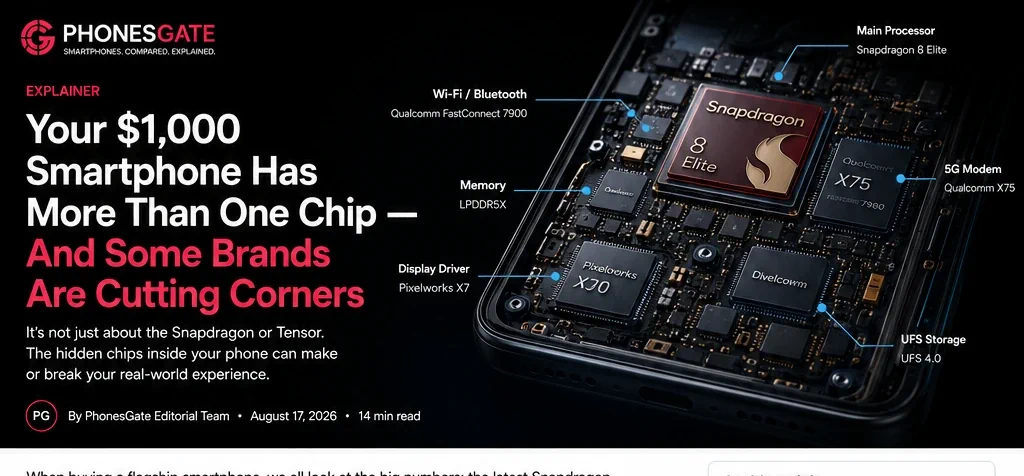
A flagship processor name no longer tells you the whole story. Two expensive smartphones can advertise silicon from the same premium family and still deliver different sustained performance, connectivity, storage behavior, thermals and battery efficiency. A modern phone is a system of processors, radios, memory, storage and power-management components — and manufacturers have more than one place to balance cost against performance.
The newest compromise: cut-down flagship silicon
An increasingly important distinction is the exact version of the application processor. A phone can use a chip carrying a familiar flagship family name without necessarily using the highest-performance configuration in that family. Lower-clocked or otherwise differentiated variants can reduce cost, heat and power while retaining much of the architecture and feature set of the premium part.
That is not automatically bad. For many users, a modest reduction in peak clock speed may be almost invisible in everyday use. It becomes questionable when marketing makes buyers assume that every device carrying the same family name delivers identical performance.
Key takeaway
A flagship processor badge does not reveal the full hardware story. PhonesGate explains how differentiated SoCs, connectivity systems, storage and supporting silicon can change a premium smartphone's real-world experience.
Your phone is a collection of specialized hardware
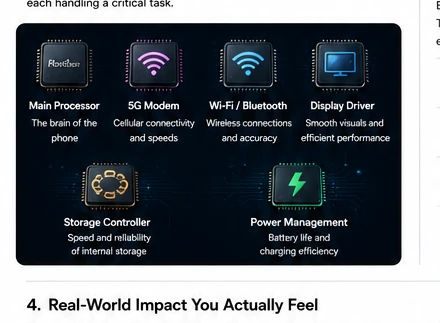
The main SoC handles CPU, GPU, AI and much of the core computing workload, but the experience also depends on cellular modem and RF hardware, Wi-Fi and Bluetooth connectivity, storage, memory, display electronics, thermal design and power-management components.
Connectivity is becoming a flagship feature of its own
Qualcomm's FastConnect portfolio shows how different wireless platforms can be. FastConnect 7900 integrates Wi-Fi 7, Bluetooth and UWB in a single 6nm connectivity system. The newer FastConnect 8800 adds Wi-Fi 8, a 4x4 radio architecture, UWB and Thread, with Qualcomm advertising peak Wi-Fi rates up to 11.6Gbps under supported conditions.
4 min read
PhonesGate coverage from PhonesGate. Published Aug 24, 2026.
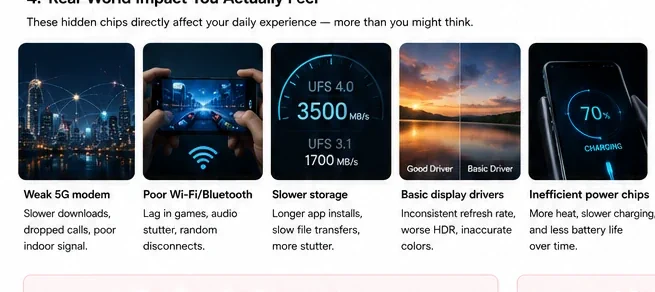
Most buyers will never see those laboratory peak speeds. The important point is that wireless systems now differ in radio architecture, supported bands, channel widths, proximity capabilities, latency and efficiency. A retail spec that says only “Wi-Fi” or “Bluetooth” can hide meaningful differences.
Where manufacturers can make trade-offs
Premium pricing pays for the complete product: cameras, display, enclosure, radios, memory, storage, cooling and software support. One manufacturer may spend more on cameras while choosing a less ambitious connectivity configuration; another may prioritize gaming thermals or faster storage.
PhonesGate does not consider every component difference to be corner cutting. The real question is whether the compromise is reasonable for the price and whether the buyer is given enough information to understand it.
Storage can change how fast a phone feels
Capacity alone — 256GB, 512GB or 1TB — does not describe storage performance. UFS generation, controller implementation and software tuning influence app installation, game loading, file transfers and demanding camera workflows.
Modem efficiency matters after the benchmark ends
A cellular modem works for hours while a phone moves between towers, bands and signal conditions. The full modem and RF implementation can influence reception, heat and battery consumption. A phone can therefore post an excellent short benchmark yet feel less refined during navigation, hotspot use or weak-signal 5G.
How to check what you are actually buying
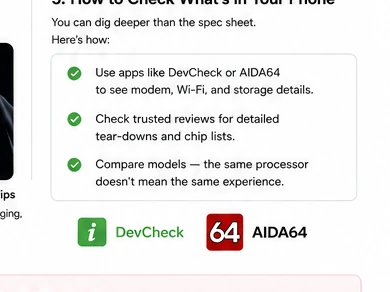
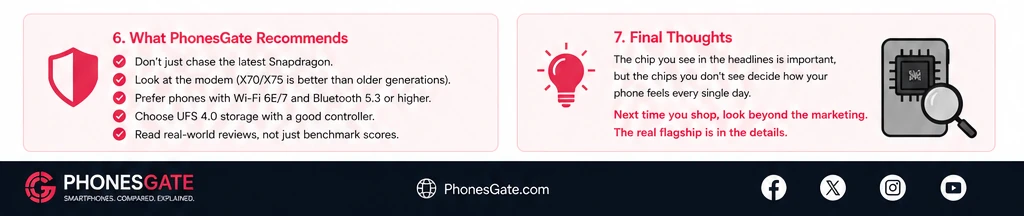
Do not stop at the processor marketing name. Check the exact SoC variant where it is published, Wi-Fi generation and supported bands, Bluetooth capabilities, UWB availability, storage standard and independent testing of sustained performance, thermals and connectivity.
What PhonesGate recommends checking first
- Exact processor variant: do not assume every chip sharing a flagship family name has identical clocks or configuration.
- Wi-Fi implementation: generation, 6GHz support, MLO and antenna configuration can matter.
- Bluetooth capabilities: the version number does not describe every audio or proximity feature.
- Storage: check the UFS generation and real loading or transfer tests.
- Sustained performance: short benchmarks can hide thermal throttling.
- Battery under mobile data: weak-signal testing can expose modem and RF efficiency differences.
Is a cut-down flagship chip automatically a bad deal?
No. A slightly reduced flagship configuration can be a sensible engineering trade if it lowers heat, improves battery life or lets a manufacturer invest elsewhere without hurting everyday performance. It can even be preferable to peak clocks that a thin phone cannot sustain.
The issue is transparency. At premium prices, buyers should be able to tell exactly which hardware tier they are purchasing.
PhonesGate verdict
Smartphone comparison needs to move beyond “Snapdragon vs Tensor vs Exynos.” The exact silicon variant, modem, wireless subsystem, storage, memory, cooling and power management collectively decide whether a premium phone actually behaves like one.
For buyers, the lesson is simple: read past the headline processor. A $1,000 smartphone should be judged as a complete hardware platform — because that is what you use every day.