

The Google Pixel 11 Pro is a difficult phone to review because the specification sheet does not fully explain why people like it. On paper, several Android rivals are faster, charge more quickly and offer larger batteries for less money. Yet after the first wave of independent reviews, one theme keeps repeating: the Pixel 11 Pro remains one of the most satisfying compact Android flagships to use, largely because Google is still unusually good at combining camera quality, software polish and small everyday features.
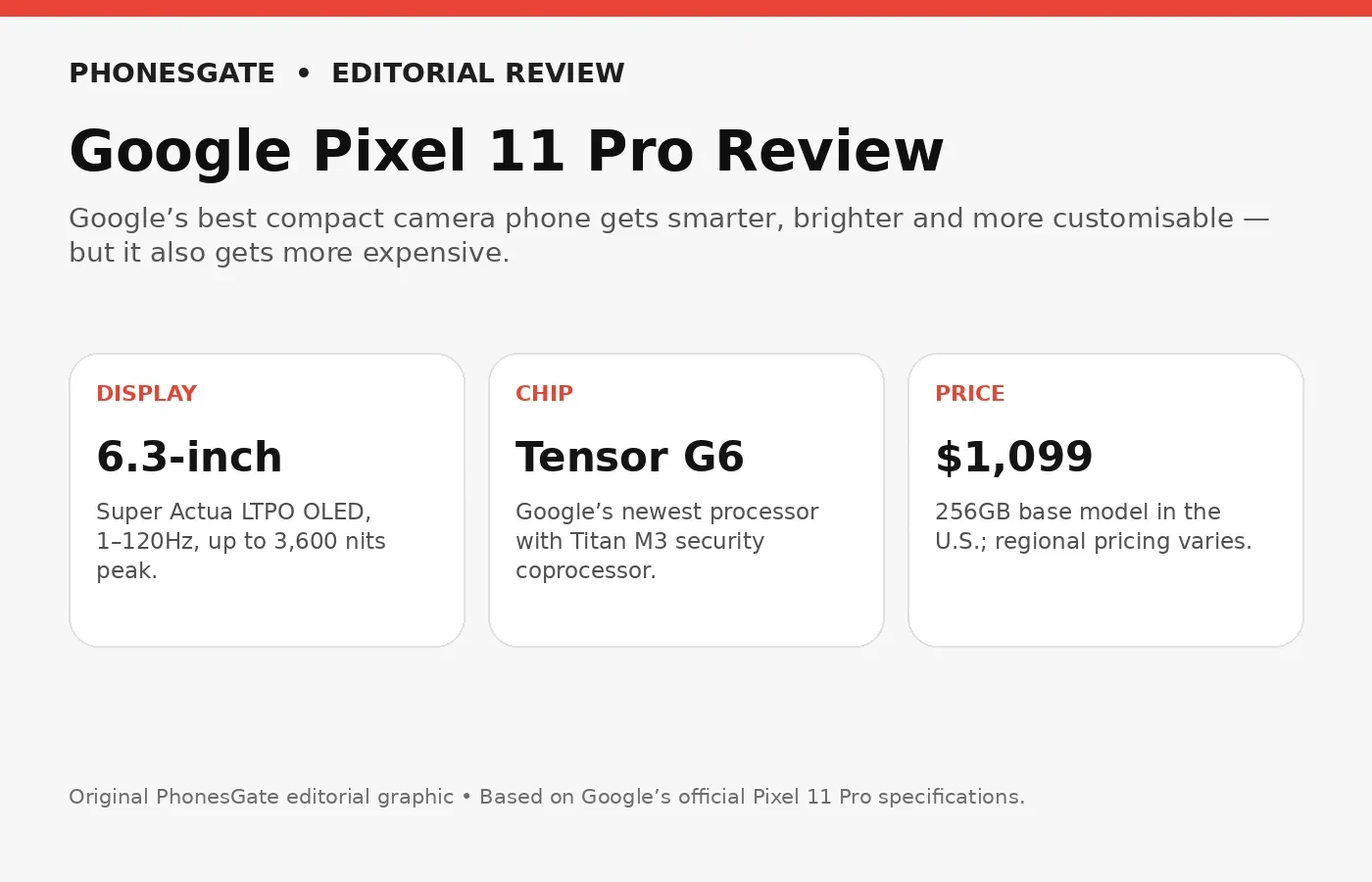
Google’s 2026 Pro model starts at $1,099 in the U.S., with regional pricing varying considerably. It uses a 6.3-inch Super Actua LTPO OLED, the new Tensor G6 processor, a triple rear camera system with a much larger 5x telephoto sensor, a 4,850mAh battery, built-in Pixelsnap magnets and Android 17.
Review methodology: PhonesGate has not pretended to use a retail Pixel 11 Pro for several weeks. This is an editorial review based on Google’s official specifications and multiple independent hands-on reviews published after launch. Where battery life, heat, camera consistency or software behavior are discussed, we distinguish Google’s claims from independent reviewer findings.
Key takeaway
Google Pixel 11 Pro combines one of the best compact camera systems with Android 17, Tensor G6, a brighter 6.3-inch LTPO OLED display and genuinely useful AI tools. The experience is excellent, but the $1,099 starting price and modest raw-performance gains make the upgrade harder to justify.
Design: still unmistakably Pixel, but more refined
The Pixel 11 Pro does not reinvent Google’s industrial design. The horizontal camera bar remains, but the overall finish is cleaner and more mature. Google uses edge-to-edge glass around the camera area, polished metal edges and a matte rear finish. The Pro is available in Canyon, Olive, Fog and Obsidian.
At approximately 152.7 × 71.9 × 8.4mm and 204g, the Pixel 11 Pro is one of the few genuinely compact premium phones left. That matters. Many flagship buyers want the strongest cameras and software without carrying a 6.8- or 6.9-inch device. Google gives them exactly that.
11 min read
Google coverage from PhonesGate. Published Sep 11, 2026.
The phone also retains IP68 water and dust resistance and uses Gorilla Glass Victus 2. Google says the newest Pro generation is more scratch-resistant than before. Independent reviews generally describe the hardware as polished and comfortable rather than revolutionary — which is probably the right way to think about it.
Display: small flagship, no obvious compromise
The 6.3-inch Super Actua display is a 1280 × 2856 LTPO OLED panel running from 1Hz to 120Hz. Google lists up to 2,400 nits HDR brightness and 3,600 nits peak brightness. At 495ppi, sharpness is not a concern.
This is one of the strongest parts of the phone because Google has not used the compact size as an excuse to downgrade the panel. Reviewers consistently praise visibility, smoothness and color quality. The adaptive refresh rate also lets the phone drop power consumption when the screen is static.
If you want the same Google software and camera philosophy with a much larger canvas, the Pro XL exists. But the 6.3-inch model is arguably the more distinctive product precisely because there are so few premium Android alternatives at this size.
Tensor G6: excellent daily performance, not the benchmark king
Google’s Tensor G6 is paired with the Titan M3 security coprocessor. Storage starts at 256GB. The 256GB model carries 12GB RAM, while 512GB and 1TB configurations move to 16GB RAM and use Zoned UFS storage.
This is where the Pixel 11 Pro’s value proposition becomes more complicated. Independent reviewers generally report smooth, reliable everyday performance, but Tensor G6 does not suddenly turn the Pixel into the fastest Android phone in synthetic benchmarks or sustained gaming.
Android Authority praised real-world smoothness and a much-improved modem, while still noting that the Tensor G6 itself is not a huge raw-performance leap. TechRadar reached a similar conclusion: the phone feels fast and dependable, but the benchmark story is not the reason to buy it.
For most people, this is not a serious problem. Apps launch quickly, Android animations are fluid and Google’s own AI features are heavily optimized for Tensor. For buyers focused on high-end gaming, emulation or maximum sustained GPU performance, Snapdragon-powered alternatives remain more compelling.
The camera system is still Pixel’s biggest advantage
The Pixel 11 Pro uses a 50MP main camera, a 48MP ultrawide with autofocus and Macro Focus, and a 48MP 5x telephoto. The front camera is a 42MP autofocus unit with a 103-degree field of view.
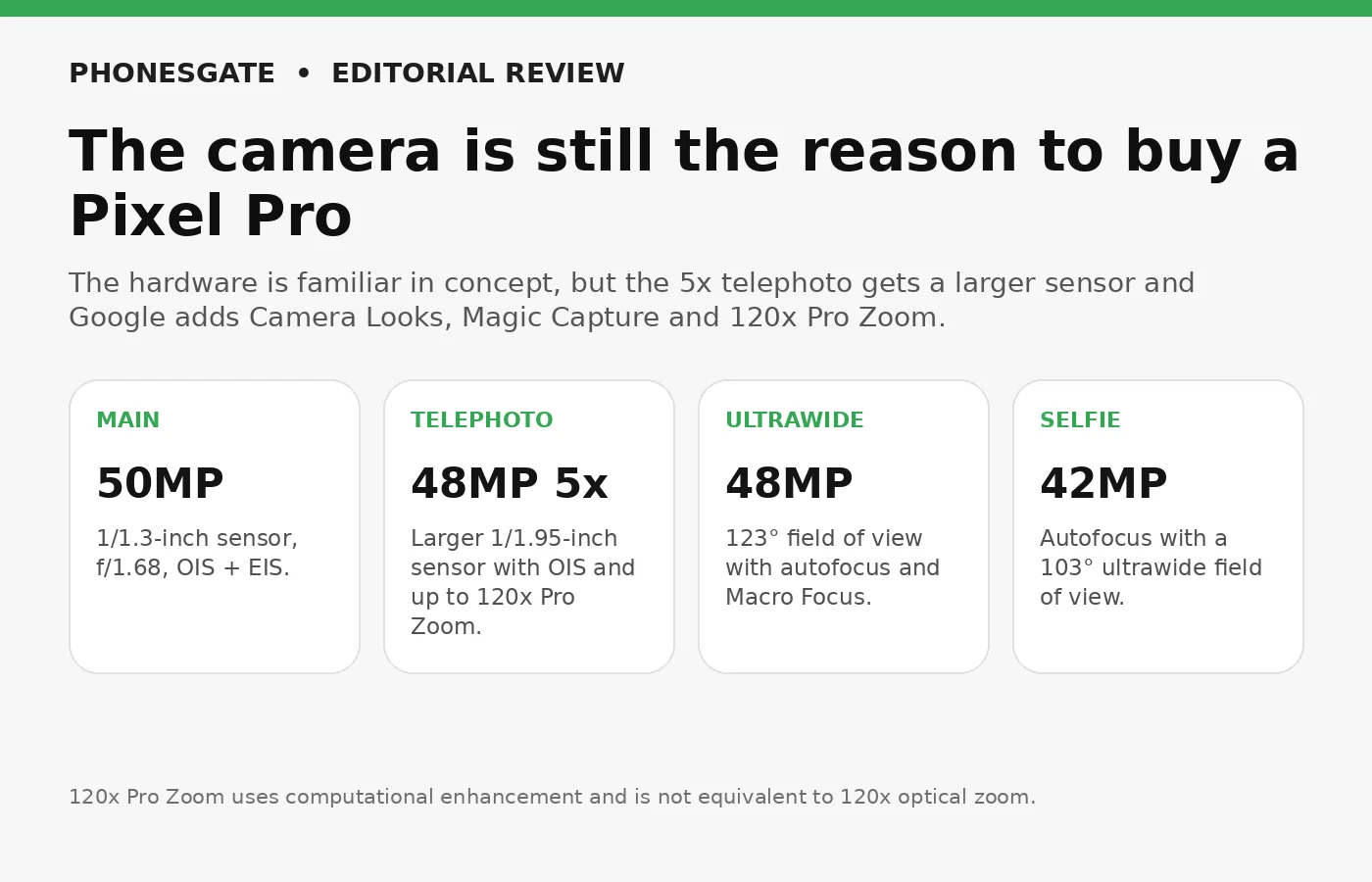
The most important hardware change is the telephoto sensor. Google now uses a larger 1/1.95-inch sensor behind the 5x lens. Google says it captures significantly more light than the previous generation, and independent camera-focused reviews generally report better low-light telephoto performance and stronger detail.
This is exactly the kind of upgrade we prefer to see. Long zoom is where small sensors struggle most because light levels drop and hand movement is magnified. Improving the actual sensor behind the telephoto lens is more meaningful than simply raising the maximum digital zoom number.
120x Pro Zoom is impressive — but it needs context
Google now advertises Pro Zoom up to 120x. That does not mean the phone has a 120x optical lens. Beyond the native camera ranges, Google uses computational processing and generative enhancement to reconstruct detail.
The results can be surprisingly usable for distant buildings, animals and landscape details, but independent reviewers have also documented limitations. Fine text can be misinterpreted, and extreme enhancement can produce details that were not truly resolved by the optics. Google restricts some generative enhancement behavior around people, but the broader point remains: 120x is a computational feature, not documentary-grade optical capture.
That does not make it useless. It simply means users should understand what the phone is doing. At 5x and around 10x, the combination of optical hardware and sensor crop is much more meaningful for normal photography.
Camera Looks may be the most important Pixel camera feature this year
For years, Pixel photography had a recognizable processing style: high local contrast, aggressive HDR and noticeable sharpening. Some people loved it; others wanted more control. Camera Looks finally gives users a way to change that character.
Independent reviewers have praised the ability to reduce sharpening, choose more neutral color, deepen tones or increase vibrancy. That turns the Pixel camera from “Google decides how the image should look” into a more personal photographic tool.
This is a subtle feature, but it may matter more than another 20x of digital zoom. Photography is subjective. Giving users control over processing style without forcing them into a full manual workflow is exactly the kind of software feature that fits Pixel’s strengths.
Magic Capture and Instant Night Sight improve the shooting experience
Magic Capture can record video and simultaneously collect still moments, then automatically curate a shareable set of clips and photos. It is designed for situations where the user wants to experience an event rather than constantly deciding whether to shoot video or photos.
Instant Night Sight reduces the waiting time associated with traditional Night Sight. Reviewers generally agree that it is faster, although motion can still create blur and there can still be a short pause in darker scenes.
The overall takeaway is that Google is trying to reduce friction rather than simply add more camera modes. That is a more useful direction than filling the interface with features most people never open.
Battery life is better than the capacity suggests
The Pixel 11 Pro contains a 4,850mAh typical battery. Google officially claims 30+ hours of battery life. On paper, that capacity looks modest next to Android phones now shipping with 6,000mAh, 7,000mAh or even larger silicon-carbon cells.
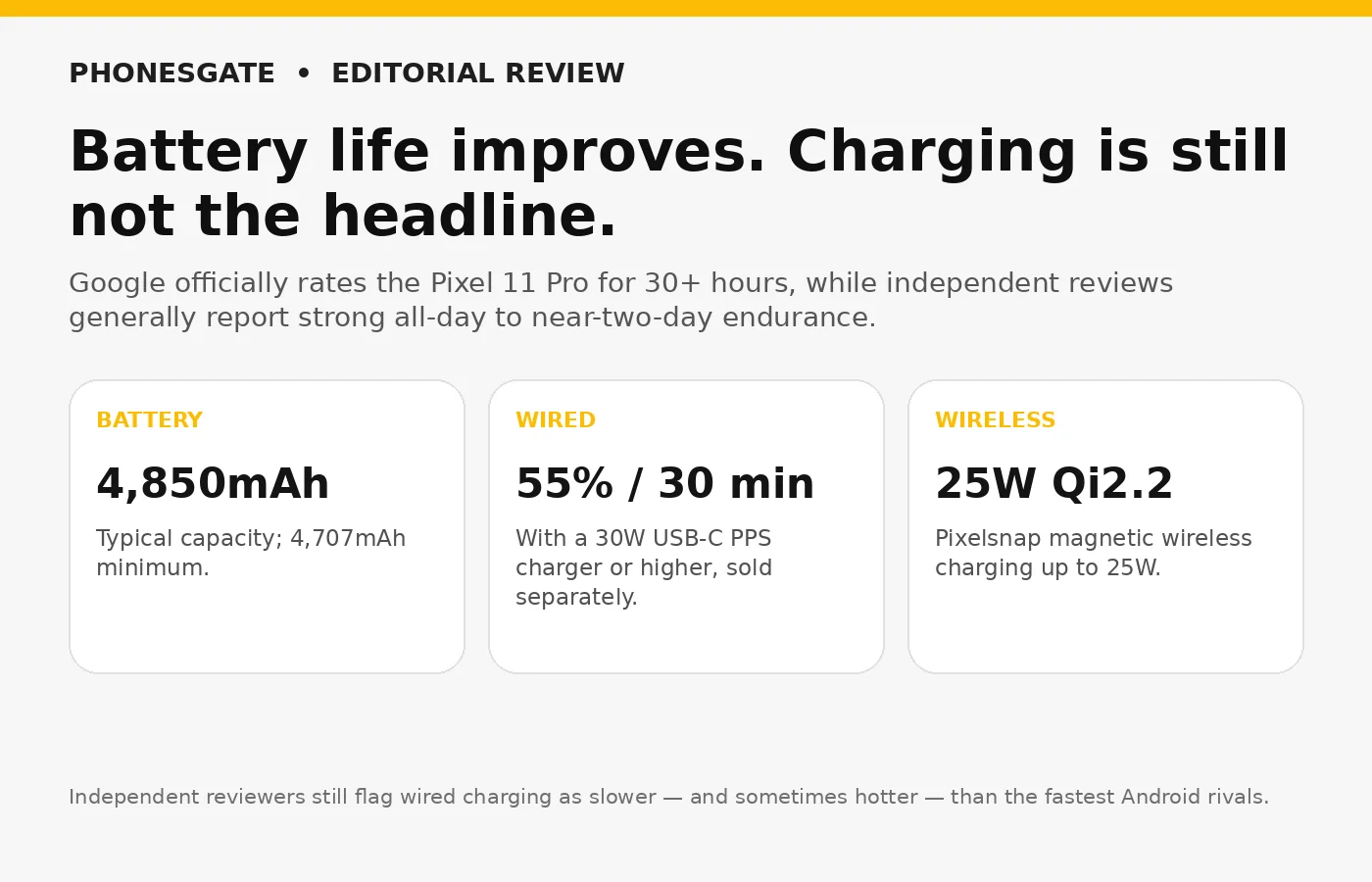
In practice, independent reports are considerably more positive than the raw number suggests. The Guardian reported battery life approaching two days under its mixed-use testing, while other reviewers consistently describe it as an all-day phone with useful reserve.
That does not make it an endurance champion. Heavy gaming, navigation and camera use will still reduce runtime quickly. But Google appears to have improved modem efficiency and system power management enough that the compact body no longer automatically means weak battery life.
Pixelsnap is excellent; wired charging is still conservative
One of the best hardware additions is built-in Pixelsnap magnetic charging. The Pixel 11 Pro supports Qi2.2 wireless charging up to 25W and works with compatible magnetic accessories, including many MagSafe-style products.
Once magnetic alignment is built into the phone, wireless charging becomes much more convenient. Chargers, stands and grips attach predictably instead of depending on careful coil alignment.
Wired charging is less impressive. Google says the Pixel 11 Pro can reach approximately 55% in 30 minutes using a 30W USB-C PPS charger or higher. Android Authority specifically criticized wired charging as slow and hot compared with modern competitors. In a market where 80W and 100W charging is common, that criticism is justified.
Software: still Android at its best
The Pixel 11 Pro ships with Android 17 and receives Google’s long-term OS and security support, extending into 2033. The clean interface is still one of the strongest reasons to choose a Pixel over another Android flagship.
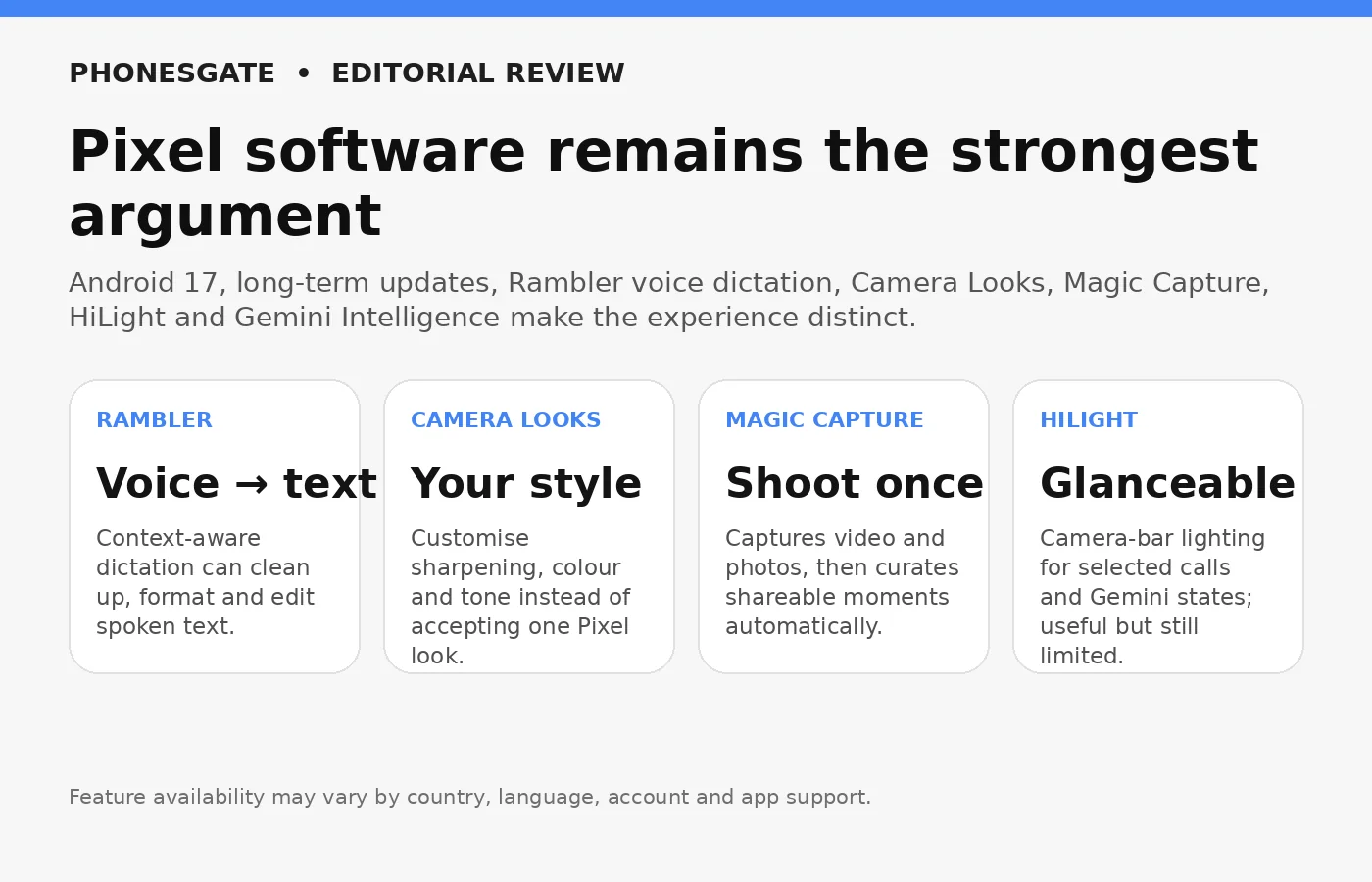
Rambler, Google’s new Gboard voice-dictation system, is one of the most consistently praised features across independent reviews. Users can speak naturally, correct themselves mid-sentence and issue formatting instructions. Reviewers describe it as unusually accurate and context-aware.
Older Pixel strengths remain as valuable as ever: excellent Call Screen behavior, spam filtering, Now Playing, strong voice transcription and a relatively cohesive Google software ecosystem.
Gemini Intelligence is promising, but not every feature lands
Google continues to push Gemini Intelligence as a core part of the Pixel experience. Some of the assistance can connect information across supported apps and proactively surface useful actions. But this is also where the independent review consensus becomes more mixed.
Android Authority found Proactive Assistance less useful than Google’s marketing suggests, and The Verge similarly described some of the proactive features as inconsistent. This matters because AI features are increasingly becoming a large part of the phone’s sales pitch.
The lesson is simple: buy the Pixel 11 Pro for the software experience that already works, not because every experimental AI feature will transform how you use a phone.
HiLight is clever, but underused
HiLight uses colored lights around the camera flash when the phone is face down. It can signal certain Gemini states and selected incoming calls. Conceptually, it is a modern version of the notification LED — something many Android users have wanted back for years.
Independent reviews like the idea more than the current implementation. Customization is still limited and the number of supported scenarios is small. Google says more capabilities are coming over time, so HiLight may become more useful later. Today, it is a nice extra rather than a reason to upgrade.
The biggest problem is the price
The Pixel 11 Pro starts at $1,099. That is $100 more than the previous generation’s starting position, although base storage now begins at 256GB. The base model also has 12GB RAM instead of the 16GB found on the higher-capacity versions.
At this price, Google is no longer asking buyers to overlook weaknesses because Pixel is a value-focused alternative. The 11 Pro competes directly with the most expensive compact phones available.
That makes the modest Tensor performance gains, slower wired charging and incomplete AI features harder to ignore. The camera and software remain excellent, but the buyer now has every right to expect a nearly complete flagship experience.
Who should buy the Pixel 11 Pro?
- Buy it if you want one of the best compact camera phones available.
- Buy it if Pixel software, Call Screen, voice tools and long-term updates matter more than benchmark leadership.
- Buy it if you want Qi2 magnetic charging without moving to a huge phone.
- Wait for a discount if $1,099 feels difficult to justify — the Pixel becomes much more compelling when trade-in and seasonal offers appear.
- Look elsewhere if maximum gaming performance or ultra-fast wired charging are priorities.
PhonesGate verdict
The Google Pixel 11 Pro is a better phone than its upgrade list makes it look. The improvements are not dramatic in isolation, but they strengthen the things Pixel buyers already care about: camera quality, compact design, software polish, wireless charging and everyday intelligence.
The larger 5x telephoto sensor is a real camera upgrade. Camera Looks finally gives photographers more control over Google’s processing. Rambler is genuinely useful. Pixelsnap makes wireless accessories better. Battery life is stronger than the 4,850mAh specification suggests.
The weaknesses are equally clear. Tensor G6 is not the fastest flagship processor, wired charging is conservative, some headline AI features feel unfinished and the $1,099 starting price is difficult to ignore.
PhonesGate rating: 4.5/5. If you want the fastest Android phone, this is not it. If you want a compact Android flagship that consistently gets photography, software and everyday usability right, the Pixel 11 Pro remains one of the strongest options of 2026.
Sources
Image note: all graphics included in this package are original PhonesGate editorial infographics created from published specifications. They are not Google press photographs and do not represent PhonesGate hands-on testing.