

For years, 5,000mAh looked like the practical ceiling for mainstream smartphones. That ceiling has broken. Phones with 6,000mAh, 7,000mAh and even larger batteries are appearing without becoming unusually thick. The biggest reason is not simply packaging: battery chemistry is changing.
Silicon-carbon changes the equation
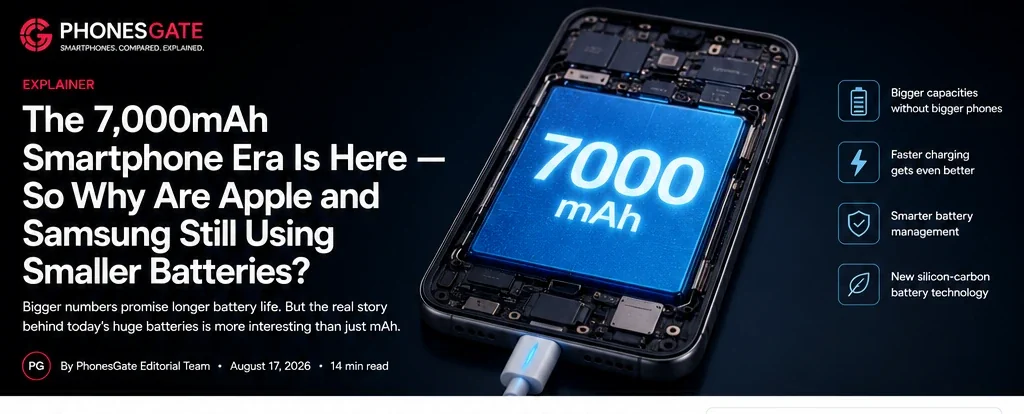
Conventional lithium-ion phone batteries generally rely heavily on graphite at the anode. Silicon can store substantially more lithium than graphite by mass, making it attractive for increasing energy density. The challenge is that silicon expands dramatically during charging and contracts during discharge.
Modern silicon-carbon designs use composite structures and battery-management techniques to control that expansion. They are not magical pure-silicon batteries; they are practical attempts to gain energy density while managing mechanical stress.
Key takeaway
Why are 7,000mAh smartphone batteries becoming common while many global flagships remain smaller? PhonesGate explains silicon-carbon chemistry, energy density, longevity and why mAh alone does not determine battery life.
Why 7,000mAh phones are possible now
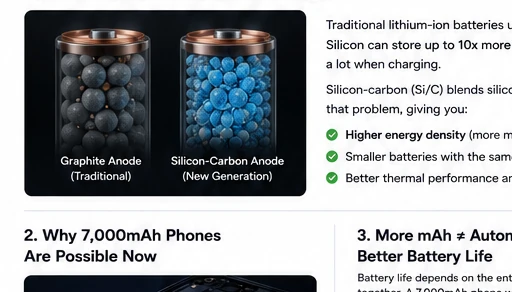
Higher energy density allows manufacturers to store more energy in a similar physical volume. That matters because the battery competes for internal space with cameras, speakers, cooling systems, wireless-charging coils and logic boards. Better packaging and more efficient chipsets add to the advantage.
More mAh does not automatically mean better battery life
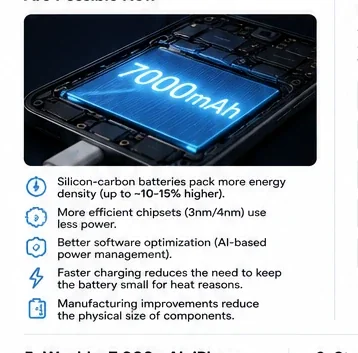
Milliamp-hours measure electric charge, not how many hours a complete smartphone will run. A 7,000mAh phone with an inefficient processor, bright display, aggressive background activity and power-hungry modem can lose to a smaller-battery phone with excellent system efficiency.
4 min read
Apple coverage from PhonesGate. Published Aug 25, 2026.
Real endurance depends on display technology, refresh behavior, chipset and modem efficiency, signal strength, software, thermals, camera use and battery age.
Why have Apple and Samsung been more conservative?
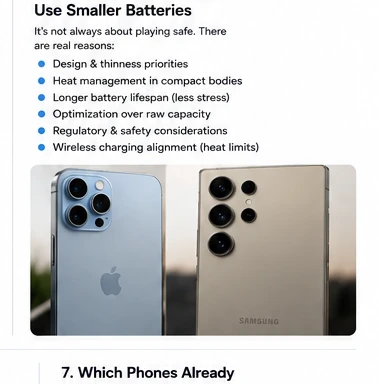
There is no single explanation. Smartphone design balances thickness, weight, cameras, charging, wireless hardware, durability and longevity. New chemistry also needs large-scale safety and degradation validation.
Samsung said in early 2026 that silicon-based battery technology had to meet its rigorous validation standards and provide a meaningful customer-experience gain before wider adoption. The company's later movement of silicon-carbon technology into newer foldable hardware shows a cautious rollout rather than rejection of the chemistry.
Shipping rules can influence battery architecture
Lithium battery transport rules distinguish cells and batteries by watt-hour ratings. A widely relevant threshold for lithium-ion cells is 20Wh, which can affect shipping classification and handling. Multi-cell designs can keep individual cells below applicable thresholds, but they introduce another packaging decision.
Would a 7,000mAh iPhone actually last two days?
Possibly, but capacity alone cannot guarantee it. Apple's hardware/software efficiency could make a much larger battery compelling, while screen time, 5G conditions, camera use, gaming and background services would still determine endurance. A larger cell would also require Apple to rebalance internal space, weight, charging and thermal design.
Stop comparing batteries by mAh only
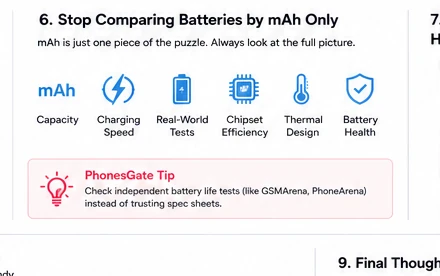
- Capacity: useful, but only the starting point.
- Energy density: determines how much energy fits into available space.
- Chip efficiency: CPU, GPU and modem consumption matter enormously.
- Display efficiency: brightness, resolution and refresh behavior affect endurance.
- Charging and thermals: speed is useful only when heat is controlled.
- Battery health: long-term cycle life matters for phones kept for years.
- Real-world testing: mixed-use endurance is more useful than a launch-slide number.
The unanswered question: long-term longevity
Silicon expansion remains the central engineering challenge. Different manufacturers use different silicon percentages, structures, charging strategies and battery-management algorithms, so “silicon-carbon” does not describe one identical technology across every phone.
Buyers planning to keep a phone for five or more years should watch cycle-life claims, warranties, replacement availability and independent long-term testing as the technology matures.
PhonesGate verdict
The 7,000mAh era is real, but the lesson is not simply “buy the biggest number.” Silicon-carbon chemistry gives smartphone designers a larger energy budget in similar space, making it one of today's most meaningful hardware advances.
A great battery remains a complete system: chemistry, capacity, chipset, modem, display, charging, thermals and software must work together. The next time a manufacturer advertises an enormous mAh figure, ask the better question: what does the complete phone do with that energy?